The new global status of CA7RIEL and Paco Amoroso is such that Free Spirits, their highly anticipated second album, was presented by Sting. Halfway between parody and marketing, the Argentine duo of the moment has experienced a dizzying rise since they exploded with their Tiny Desk concert. While in the EP PAPOTA they laughed at fame, in their new work they address its consequences.
Notably, they decided to go to a different place; instead of repeating the winning formula, they created imaginative, expansive, and unpredictable pop that does not skimp on catchy choruses and danceable rhythms. In Nada Nuevo, they take charge of expectations and make it clear that their approach is more about surprise than originality. Meanwhile, No me sirve, Ay ay ay (featuring Anderson Paak), and the rumba Vida loca lean into movement with nods to Latin music.
The album also includes electronic influences and even ventures into a 70s-style ballad with the excellent Himno del Mediocre, one of the album's highlights. In the funk track Soy increíble, they come closer to what they were known for, closing with a solid guitar solo from CA7RIEL. In summary, a well-crafted album that sounds like the duo while also challenging expectations.
To find the girl she once was, Natalia Pérez, known as Cancamusa, looked back and searched through her memories. Today, she turns those memories into song. The artist releases the first version of her career with her interpretation of Entre mis recuerdos, originally by Albert Hammond and popularized by the Spanish artist Luz Casal.
That was the version she knew, like most of the Latin audience, a melancholic and introspective song. In contrast, the …
The guitar phrases from Duran stand out—starting with a nod to the original theme—and the drumbeat, played by Cancamusa herself, gains presence in the mix. The string arrangement by Martín Benavides, recorded by Cuarteto Austral, somewhat emulates what the keyboard does in the Spanish version and underscores the melancholy of the lyrics. Cancamusa successfully takes ownership of the song, and by singing in her own style, she showcases the experience she has gained as a performer.
A well-crafted version. Terry Brown was to Rush what George Martin was to The Beatles. He not only produced 10 albums for the Canadian trio (eight studio and two live), but he was also a guiding force during the band's most significant musical transition, when they shifted from progressive rock to a more "radio-friendly" sound.
This transition marked the move from Hemispheres (1978) to Permanent Waves (1980). In the early 80s, when the group sought to consolidate another phase, that of synthesizers, Terry Brown left his work with Rush. Thus, Grace Under Pressure (1984) became the first album without Brown as producer.
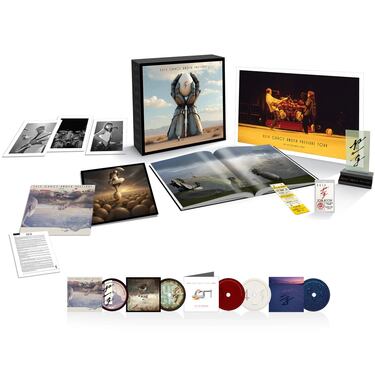
Recently, Geddy Lee and Alex Lifeson—who recently announced their return with a world tour, with Chile still in doubt—released the 40th anniversary edition of this work, which includes tracks like Distant Early Warning and Red Sector A. The box set includes five discs: the remastered album, a Dolby Atmos mix, the complete live concert in Toronto 1984, and a new version mixed by Terry Brown. It is precisely this last piece that stands out, serving as a sort of missing link in the long history of the band.
Here, there is a more elegant and prominent presence of keyboards, along with other subtleties like the ending of Red Lenses.