“It is a test flight and is not without risks, but our team and our hardware are ready,” said Lori Glaze, a senior NASA official, in mid-March. After numerous delays due to technical issues, the agency announced that humanity will attempt to return to lunar orbit during a window that opens on April 1, in the Artemis II mission. Fifty-three years after the last crewed operation to Earth's natural satellite, NASA's risk management team unanimously voted in favor of the project.
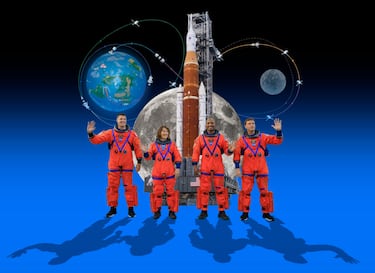
In December 2022, Artemis I consisted of the uncrewed flight of the Orion spacecraft around the Moon. Now, four astronauts will be aboard. During a 10-day mission, the four crew members of the capsule—Reid Wiseman, Victor Glover, Christina Koch, and Jeremy Hansen—will test the spacecraft and conduct various experiments.
This is a step closer to Artemis's ultimate goal: to land on the Moon in 2028 and establish a sustainable presence there. Additionally, if the operation is successful, Koch will be the first woman to orbit Earth's natural satellite. “In this mission, the main experiment is the astronauts themselves,” says Mathieu Caron, director of the Canadian Space Agency's Astronaut Operations Department, which collaborates with NASA on Artemis II and contributed one of the mission's crew members: Jeremy Hansen.
“The critical objective is to validate that the crew systems—controls, displays, and life support—function correctly with humans onboard,” Caron adds. “Jeremy always says: ‘I am the experiment’,” he adds. Since NASA's main goal is to prove that the Orion capsule is suitable for human use in subsequent landing missions, Dr.
Phillip Anderson, director of the W. B. Hanson Space Science Center at the University of Texas, compares it to the Apol…
“When the Apollo missions were heading to the Moon, they did something very similar. Apollo 8 simply orbited it. It was to demonstrate that we could reach the Moon and safely bring the crew back,” Anderson states, adding that Apollo 9 and 10 were similar.
“Therefore, these missions were about testing the technology and ensuring it would work before Apollo 11 actually landed on the Moon,” he adds. “We need this mission to be successful if we want to reach the lunar surface,” adds Dr. Gordon Osinski, who has been training NASA astronauts in planetary geology for over a decade, including two crew members of Artemis II recently.
Dr. Osinski took crew members Christina Koch and Jeremy Hansen to study the Mistastin crater in the Canadian province of Labrador. Although the main goal of Artemis II is to test the Orion capsule, the astronauts will take advantage of the mission to study the far side of the Moon.
“The Artemis crew will see the Moon in a way quite different from the Apollo missions because they will be farther away,” Osinski states. “They will be able to see the entire lunar disk, and they will be able to see things like the change in lighting on the surface,” he adds. In the Apollo missions, astronauts orbited 110 kilometers above the lunar surface.
Now, the crew members of the Orion capsule will be at a distance of between 6,500 and 9,500 kilometers from the celestial body. According to a NASA report, “at its closest point, the Moon will appear to the Artemis II crew the size of a basketball held at arm's length. ” “They will monitor the dark regions of the far side of the Moon for impacts (from meteoroids) in real-time,” Osinski adds, noting that these resemble the flash of a camera being fired on the lunar surface.
Additionally, when they orbit between shadow and sunlight regions, the crew will have the opportunity to see “dust rising into the lunar exosphere,” he adds. This phenomenon is significant. Lunar dust represents one of the greatest obstacles to NASA's ambition to establish a “sustainable lunar presence.
” This is a highly corrosive material that clings to spacesuits and is toxic if inhaled. Dr. Osinski hopes that eventually, “the Moon will be like Antarctica, where we have advanced scientific outposts.
People travel there for a couple of months, or maybe a year. ” Thus, “we would really start to understand the geology of the Moon,” he states. Eight minutes after the launch of the 97-meter-long rocket—called the Space Launch System (SLS)—from Kennedy Space Center in Florida, the Orion spacecraft will be in space.
This will be the first time the SLS and the spacecraft will be tested with humans onboard. Former astronaut Barry “Butch” Wilmore, a crew member of the Space Shuttle Atlantis, knows firsthand the risks of these operations. Before becoming an astronaut, Butch survived 21 combat flights in Iraq in the United States Air Force.
Later, during his time at NASA, he participated in four space flights, where he served as commander of the International Space Station (ISS). In his last flight of this type, in 2024, a failure in the thrusters of Boeing's Starliner spacecraft left him stranded in Earth orbit for nine months. According to Butch, the main challenge for the mission is “using a new spacecraft, with the crew onboard interacting with all its capabilities.
” Besides that, the former astronaut points out two sensitive moments in the operation. The first will be the flight tests that the Orion capsule will perform with the propulsion module responsible for pushing it toward the Moon when both are in Earth orbit, “which means flying the spacecraft in proximity to the Interim Cryogenic Propulsion Stage,” Butch explains. The second key moment is the translunar injection, which is the maneuver to exit Earth's orbit.
“It has to be done at the right moment because the thrust that takes you to the Moon is the same that brings you back home,” which is called a “free-return trajectory,” Butch adds. According to Anderson, a space weather specialist, “between Apollo 16 and Apollo 17, there was an X-class solar flare—the highest category—that, had it occurred while the astronauts were on the Moon, would have killed them. ” Dr.
John DeWitt, who worked for 20 years at NASA's Johnson Space Center in the Astronaut Health and Performance Department, explains that “Earth has a protective barrier that reduces harmful radiation,” a protection that “disappears when we travel beyond. ” In the event of a large solar flare, DeWitt explains, astronauts must put the Orion spacecraft's cargo between themselves and the sun to avoid being hit by solar radiation, as it could exceed the spacecraft's protections. If such an event is detected from control satellites in Earth orbit, Anderson states, “we have a little time to warn the astronauts to take cover.
” This warning could arrive “tens of minutes” before the charged particles arrive, he adds. Not all risks are in outer space. The thermal shield of Artemis I, the previous mission, melted more than expected during re-entry to Earth.
Along with the liquid hydrogen leak from the launch rocket, these were the two main causes of the delay of Artemis II. However, mission engineers claim to have solved these problems. In the confined space of the Orion spacecraft, the four crew members of the mission will have specific roles.
Reid Wiseman, who served as Chief of NASA's Astronaut Corps for three years, has been designated as the mission commander. After being an engineer on the International Space Station in 2014, he has 165 days of experience in space. Victor Glover, a U.
S. Air Force pilot with experience in 24 combat flights, will be responsible for piloting the Orion spacecraft. As an astronaut, he spent 168 days on the ISS.
Additionally, he will be the first person of African descent to orbit the Moon. Jeremy Hansen and Christina Koch have been designated mission specialists. Hansen, of Canadian origin, is the first non-American to go to the Moon, and this is his first venture into space.
On the other hand, Koch is the fourth person to have spent the most consecutive time in space in NASA's history, with 328 days to her credit.