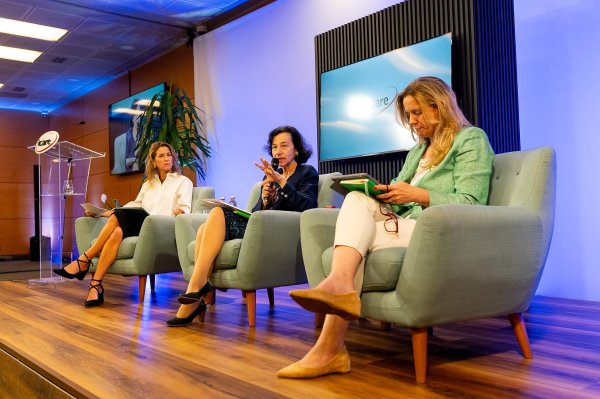
The president of the Central Bank, Rosanna Costa, presented the Monetary Policy Report (IPoM) for March this morning to business leaders at a seminar organized by the Chilean Institute of Rational Business Administration (Icare). In her presentation, she addressed the current context of uncertainty due to the war in Iran, which framed the new projections for the Chilean economy, adjusting the inflation forecast for December of this year from 3. 2% to 4%, and projecting a return to the target by 2027.
At the same time, she revised the GDP growth estimate downwards, from a range of 2% to 3% to between 1. 5% and 2. 5% for this year.
"The scenario considers the evolution of a war, which implies what future prices will be, and it may last a few more weeks," she indicated. She added that "once it ends, the costs of resuming product offerings and recovering the supply that existed are relatively quick. Therefore, this depends on there being no destruction of wells, refineries, etc.
, and that the passage through the Strait of Hormuz somehow recovers to reasonable levels. " Still, she warned that there could be many variations in response to this scenario. However, she also mentioned that if the war were to last longer, it could have a greater impact that would not only be transmitted through prices but also affect the ability to recover production through global channels and production costs.
"And that is a scenario that, if it deteriorates deeply, could lead us to a more adverse situation from the perspective …
Fiscal Outlook On the internal front regarding the fiscal adjustment of US$3 billion, Costa affirmed that it is incorporated into the Central Bank's scenario. "This naturally translates into lower public consumption, lower public investment, and has an impact on demand that is reflected in the report. It also helps to mitigate the effect of prices.
In some way, it is also influencing that direction in the medium term," she explained. She added that "there are other elements within what will be the implementation of fiscal policy and other policies, but that are not yet possible to incorporate. " "That is why we are cautious in stating, and the report mentions in one paragraph, that as this is incorporated, it may have a different effect within the macroeconomy.
As a proper shock, it could have an opposite effect and be part of some components on the demand side that are not included. This will need to be analyzed as it unfolds," she indicated. She added that "there has just been a change of government, and we still do not know the fiscal rule that will be considered for the next period.
All these elements will need to settle and will be incorporated in upcoming reports. " Regarding the current investment outlook, the president of the Central Bank noted that "it shows high growth rates," with imports of machinery and equipment that, although they have had somewhat lower rates, "continue with significant dynamism and were coming from very high rates. " "Therefore, we see that this dynamism continues, and these lower imports are also behind this adjustment we have made in the growth rate on the investment side for this year, without a doubt," she explained.
In this way, she indicated that what is most marking the growth in investment is the inventory of capital goods, primarily energy projects that are driving up the amounts over the five-year period. "We have successively seen increases, but mining, energy, and especially energy are the projects," she indicated. However, she also noted that "we have seen intentions to incorporate very large projects into the inventory," which have a longer maturity and would be pushing construction and works.
"There are projects that need to be supported and will be mobilized with some delay as these sectors and projects materialize," she explained. Adding that in the case of residential construction, "we were seeing higher sales levels and there was a change in the sector's expectations and a change on the sales side. We are not saying it is a significant change, but something was beginning to take shape.
" Safe Haven in the Dollar Costa also addressed the reaction of financial markets to the war situation. "After successive and prolonged events that are stressing them, they have been reacting quite in line, one might say reasonably, in response to the magnitude of the shocks that have been observed, and our market has been quite aligned with what we are seeing in global markets as well," she explained. She added that "there is a correlation in the reactions across different markets, and they have had the capacity to absorb the shocks without generating—obviously, there has been volatility, and these are significant impacts—but in the end, one can say that the markets have had the capacity to absorb all these events reasonably.
" Thus, she recalled that in previous events, she had noted how the correlation between financial variables was not occurring in the same way and how safe havens were not always sought with the same intensity, at least in American safe assets. "And this time, after the initial reaction, what we are seeing is that there is again a search for refuge in the dollar. I think that is a distinguishing factor of this process," she said.
Internally, she explained that "we have been aligned, and from the perspective of especially longer-term rates, we will be aligned with international phenomena. The difference can be made by the levels of risk, so if we manage risks internally, we will have that alignment.