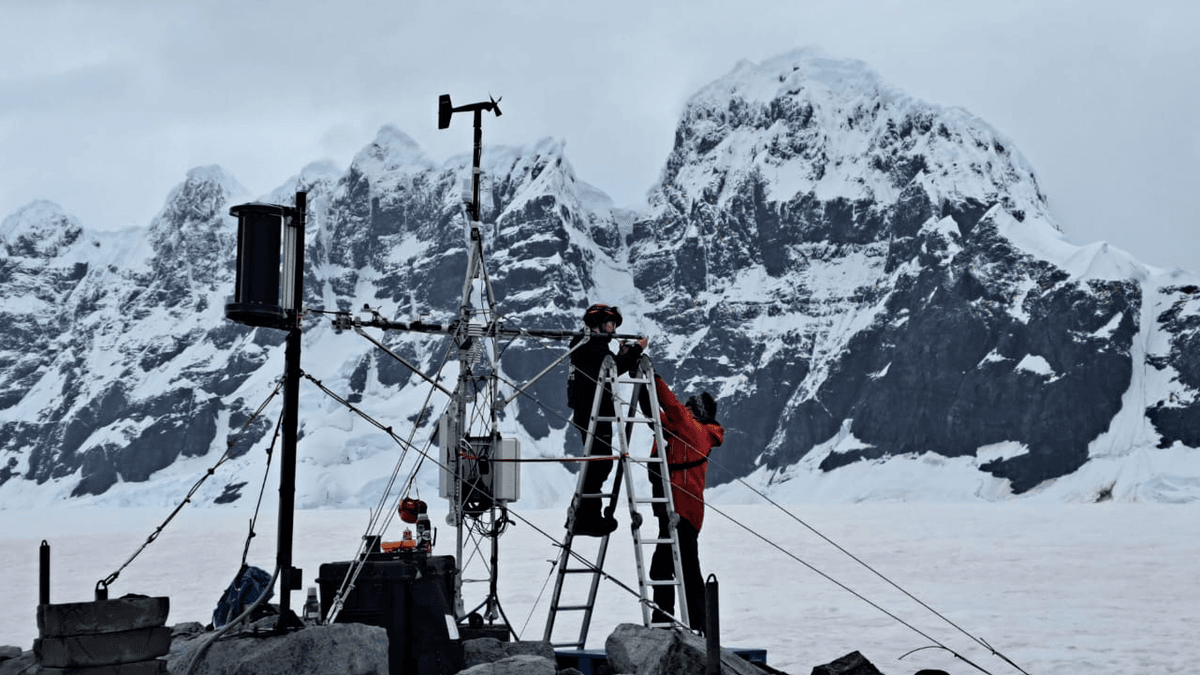
During the LXII Antarctic Scientific Expedition (ECA 62), a team from the Chilean Antarctic Institute (INACH) traveled to various points in the Antarctic Peninsula to ensure the operation of automatic weather stations that record the atmospheric pulse of the White Continent in real time. These devices, part of the Latitudinal Sensors project, generate open data for the scientific community and strengthen Chile's role as one of the most advanced countries in the region in climatological matters. Currently, the project's network includes 17 measurement points distributed across different areas of Antarctica.
During this campaign, renovation, improvement, and maintenance work was carried out at stations located on the Unión Glacier, Mountain School, Prospect Point, Cape Melville, O'Higgins Base, Prat Base, D'Hainaut Island, Alcock Islet, Gabriel González Videla Base, and Punta Py, in the vicinity of Yelcho Base, in addition to the installation of two new stations on Mount Vinson and Detaille Island. This deployment was conducted aboard the ARC Simón Bolívar ship of the Colombian Navy, under international cooperation agreements that allow Chilean teams to expand their operational reach and collaborate with researchers from Colombia, Ecuador, and Venezuela. Cooperation is crucial as it enables coverage of many more points, generates new contacts, shares information, and facilitates improvements from an international perspective, says Cristofer Huenchumán, an automation and industrial control engineer from INACH's Projects unit, who participated for 53 days in the campaign responsible for maintenance tasks at four stations in the network.
Fieldwork requires a combination of planning and flexibility. Two of the points were accessed via helicopter landings and two others by boat, with four to five-hour windows at each site to intervene in structures and sensors, conditioned by weather, sea state, and the ship's ability to adjust its itinerary to the needs of participating countries. Conditions can change very quickly.
For example, on D'Hainaut Island, we were working when suddenly a snowstorm hit, forcing us to halt maintenance and seek shelter, recounts Huenchumán. Arriving wet on shore, combined with wind and low temperatures, can drastically reduce the safe operating time available on Antarctic soil. The Antarctic Climate Change Observatory Sensor Network records variables such as air temperature and humidity, CO2 concentration, wind direction and speed, soil temperature, solar radiation, photosynthetically active radiation, and atmospheric pressure through its stations.
In this case, the aim is purely scientific. I focus on generating the data and ensuring its quality, explains Huenchumá…
In addition to sensor work, the campaign included efforts to collect remnants of the old Federico Puga refuge at Punta Spring, aiming to reduce human impact on the White Continent and advance the cleanup of historical structures that have reached the end of their useful life. Ignacio Reyes from INACH's Expedition Department is still working on this task as part of the same operation. Meanwhile, the Sensors team is developing a new version of its web platform to facilitate access to network information.
This update aims to improve the visualization of stations on the Antarctic map, simplify data downloads, and allow users to graph and analyze the behavior of variables over different time scales. This way, researchers working in diverse fields such as atmospheric or biological sciences, to name just a few, will be able to more easily integrate meteorological data into their studies; for example, to relate the activity of penguin colonies to the climatic conditions they face in their habitats. The Chilean Antarctic Institute (INACH) is a technical body of the Ministry of Foreign Affairs with full autonomy in all matters related to scientific, technological, and outreach Antarctic affairs.
INACH complies with the National Antarctic Policy by promoting the development of excellent research, effectively participating in the Antarctic Treaty System and related forums, strengthening Magallanes as a gateway to the White Continent, and conducting outreach actions to disseminate Antarctic knowledge to the public. INACH organizes the National Antarctic Science Program (PROCIEN).