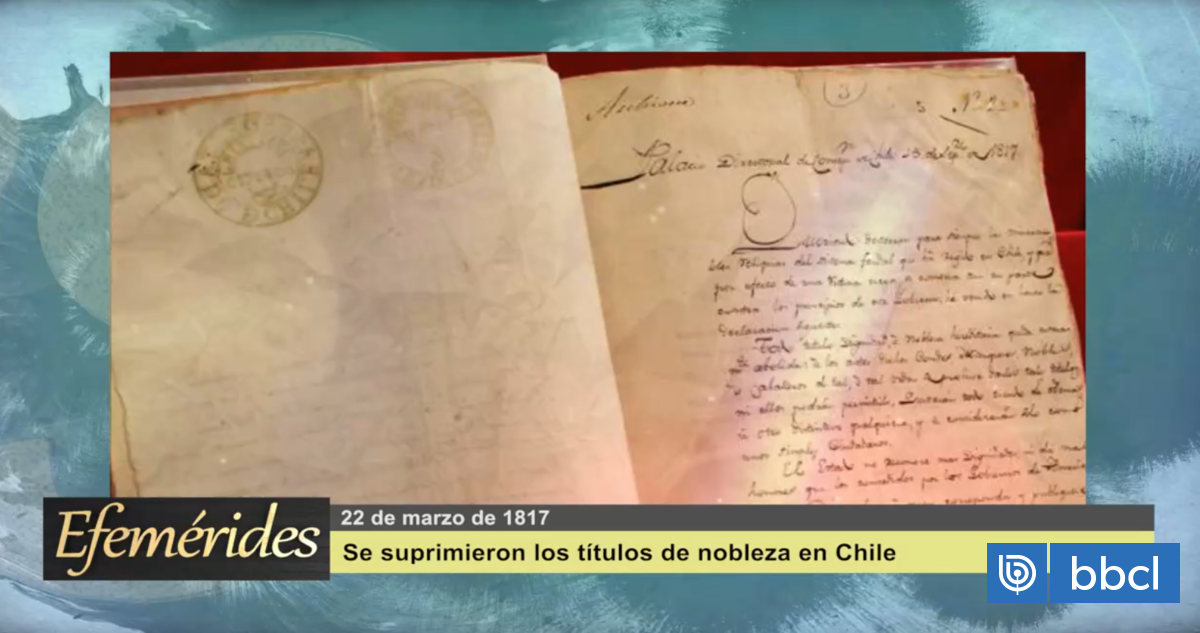
On March 22, 1817, the government of Bernardo O'Higgins ordered the suppression of noble titles in Chile. Although since the times of the Old Homeland there had been talk of a democratic country promoting equality before the law and eliminating privileges, noble titles, coats of arms, and family trees remained present in society—mainly in Santiago. The end of noble symbols At that time, the proverb "merchant father, knight son, beggar grandson" was well-known, reflecting the transition from wealth gained through hard work to idleness and, ultimately, misery.
Fortunes disappeared quickly, but not the titles or coats of arms, which many families displayed in visible places in their homes. The decree signed on that March 22 established that, if in any society an individual must distinguish themselves by their virtue and merit, in a republic it was intolerable to use symbols proclaiming the nobility of ancestors, often granted as a reward for questionable services. In this context, it was ordered that all coats of arms and noble insignia be removed from facades within eight days.
The decree was published on March 26 in the Government Gazette, accompanied by an editorial note criticizing the "fanaticism of nobility. " From then on, these symbols were eliminated, destroyed, or covered, although some persisted for decades. Six months later, on September 13, another decree definitively abolished hereditary noble titles and any decoration not awarded by free governments of America, thus consolidating the measure initiated in March 1817.
In this video, Nibaldo Mosciatti narrates this moment that marked history.