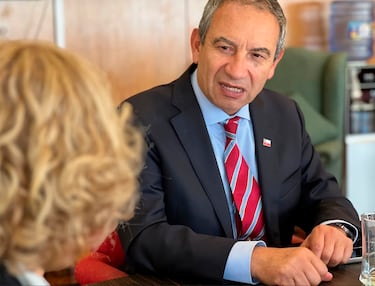
Admiral (R) Alberto Soto of the Navy, since taking on the role of presidential commissioner for the Northern Macrozone, has moved to Iquique, which will be his operations center. From there, he will coordinate presidential delegates to foster inter-agency cooperation aimed at expediting efforts to control irregular migration. Soto speaks with the confidence of someone who knows what he is doing.
His appointment was on March 11, but he recounts that he had been focused on studying the Border Shield plan for at least three weeks, which he will implement. Despite the monumental task at hand, the commissioner is confident that he will succeed in what could be one of the most complex assignments of this government. The former number three in the Navy believes in himself.
"The State of Chile has probably prepared me like very few officers in history for this," he says. He adds, "If a person like me doesn't have faith in themselves, something is wrong with their mental structure. I have a lot of faith in myself, but more than that, I have great confidence in my team's ability to work together, and I have a lot of confidence in our capacity to unite wills, far beyond politics.
" In this interview, he mentions that his position is temporary and hopes it will last two years. When discussing the technological investment needed at the border, he acknowledges that efforts began in the previous government with the Integrated Border System (Sifron), but states that it is not enough and he will intensify it during his tenure. He also adds that the first thing he hopes to see is a change in the trend of clandestine entries.
He is convinced that the symbolic effect of President José Antonio Kast's political message on this issue will be key. …
The message is clear: irregular immigrants are not welcome," he asserts. What does this plan you have named Border Shield consist of? First, it is important to clarify that the Border Shield plan is multidimensional.
This means it has a legal dimension, for example, transforming irregular entry into a crime. These and many other legal and regulatory measures are part of the plan. Second, there is a dimension aimed at creating a technological barrier.
The idea is to replace human observation and attention with a technological barrier, including projects like the digital wall and Sifron. The latter, for example, was advanced in the previous government, with nearly $13. 8 million spent.
The goal is to urgently continue this to bridge the technological gap at the border. The third dimension is management. Finally, there is the mobility barrier, which includes various tools.
What tools are we talking about? We have 1,100 kilometers of border, and we cannot fill it with trenches; that is impossible. When some believe we are creating a Maginot Line and say that walls do not work, they are right, but because this plan was never conceived that way.
So, of those 1,100 kilometers, how many will have trenches? In the vulnerable border kilometers, as the rest are canyons in an environment at four thousand meters above sea level. Besides the canyons, there are other areas with impregnable mountain ranges and wetlands that are impossible to traverse.
In winter, people can die there; it is very risky, and those areas are less vulnerable. The vulnerable areas are in the high plateau, where there is no way to stop someone from crossing; there are no fences, nothing, just an imaginary line. Those vulnerable areas are where we will intervene with anti-mobility tools, but not continuously.
How will you do it? We will install those tools at the crossings declared as irregular, which then lead to flat areas that people traverse. By intervening, we will direct the flow of irregular phenomena toward sectors that we can control or that are already being controlled, thus optimizing the use of human resources.
This is called generating convergence zones. That is what we will do, and within all the structures, we could also create a trench, and that study is being done in conjunction with the Army, the Ministry of Public Works, my team, and many experts. How many kilometers are those vulnerable areas?
There are about 400. Now, if we close those crossings, they will create others, and so on. We know that, but it will cost them more each time.
And when it costs much more, we will continue to advance. How much progress have you made in recent days? We have made little progress, but it is continuous work.
We advance between 50 and 100 meters daily. In Tarapacá, we need to build approximately 30 kilometers. In Antofagasta, another 30, and initially, there will be about 100 kilometers of obstacles against mobility, some with trenches, others probably combined with walls, concertinas, or Swedish hedgehogs.
I could name different types of walls, but I think it is understood that the concept is not just trenches. Trenches, yes, when appropriate, but never alone. Do you have maintenance planned?
There is wind there, Bolivian winter; they can easily get covered. They need to be maintained, of course, and that is included in the budget. They must be checked at least once a year, depending on the rains.
If we have an area that is a wetland, where there is livestock, we will place a wall to prevent the livestock from falling into the trench. The same maintenance will apply to the technological equipment of Sifron. The idea is for this to function organically because we are creating a border system for the next migration crisis.
You have been criticized for promoting an ineffective plan. They have labeled it as sensationalist. What is your response to that?
I understand that debate, but it is artificial. As I have already said, this is not just a trench by itself; it is much more. You can have all the trenches in the world, but if you provide free education and health and prioritize housing construction and subsidies for everyone, they will jump over the trench, take risks, and enter by sea.
That is why we need to disincentivize, and that is why we have a system of multidimensional measures. What is your goal? To know how to measure your work later.
The first is to expect a significant change in trend. Second, there is the speed of implementation of the measures. We believe that the physical anti-mobility shield at the northern border should be completed in about two years at most.
Probably the first elements will be finished sooner. The technological shield will require a flow of resources for the next four years. If the anti-mobility barrier is not finished in two years, believe me, we will do everything in our power to complete it in half the time, but sometimes the high plateau winter destroys everything.
If by the end of the year I do not have a significant part of the trench construction completed, sectors with finished walls, and other types of barriers, then we are moving slowly. And if in three years all the missing Sifron equipment is not ready, we have failed. In other words, by March 2028, the physical barrier should already be installed and well advanced, but I am being extremely conservative.
If we start five days after taking office, I believe we can do it quickly. At first, there will be criticism; that is normal. I take them in and correct what is necessary.
That is part of the zero ego attitude. The president sent this commissioner, who could be anyone else, to advance as quickly as possible. In the logic of an anti-mobility barrier with different tools, do you think it is necessary to reevaluate Chile's permanence in the Ottawa Treaty to use landmines?
It is not for me to comment on that. It is a matter that the Foreign Ministry will have to evaluate. Of course, it is a tool available, but it is not for me to assess it at this moment.
What concerns me is to implement what is in the plan, and what you are asking me is not in the plan. I could make recommendations, but it is not within my purview to do so.