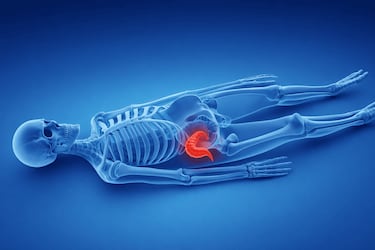
Not much can be said about the appendix, as there isn't much to comment on. It is an organ located in the lower right abdomen, connected to the large intestine, and has a bad reputation for not serving any specific function (except for becoming inflamed, causing pain, and requiring surgery). So, if it serves no purpose, why do we have it?
Science suggests that the reason dates back centuries and is related to evolution. Charles Darwin, the famous English naturalist who developed the theory of natural selection, described the appendix in his book "The Descent of Man" as a remnant from ancestors with larger digestive organs in our body. This is the concept of the appendix that has become popular in both the medical community and among the general public.
However, a group of professionals discovered that this perception may have changed over the years with evolution, and that the appendix is, in fact, a much more complicated organ than previously thought. The shape and structure of the appendix vary greatly among species. This suggests that it is an organ that has been modified through evolution, likely more than once.
Humans (and great apes) have a long, cylindrical appendix, while marsupials like koalas have a short, funnel-shaped appendix. According to a study, this structural diversity suggests that evolution has modified this organ depending on the ecological conditions of the species. Another study that analyzed a broader sample found that the appendix has evolved independently at least 32 times in 361 species of mammals.
But what does this mean? When an organ evolves repeatedly and independently, biologists refer to it as convergent evolu…
Essentially, it is unlikely to be an evolutionary accident. The appendix contributes to the immune system. It contains immune cells embedded in the intestinal wall that help control intestinal microbial activity, according to a study.
In the early years of life, the tissue present in the appendix aids in the development of intestinal microbes, allowing the body to learn to distinguish between harmful and harmless bacteria. This occurs particularly in childhood and adolescence, when the immune system is not yet fully developed. Research suggests that the appendix also acts as a microbial refuge, providing an environment where microorganisms reproduce and coexist.
Other studies also suggest that this organ is covered by biofilms, which are complex communities of microorganisms that grow attached to the appendix and produce a protective layer to shield themselves from antibiotics and disinfectants. When we suffer from a severe gastrointestinal infection, the vast majority of the intestinal microbiota dies. However, the beneficial bacteria found within the biofilms of the appendix can survive and help repopulate the intestine with beneficial bacteria, which facilitate digestion, reduce inflammation, interact with the immune system, among other functions.
If the appendix helps preserve the microbial stability of the intestine, does its removal have consequences? Older research suggested that appendicitis could affect fertility in women; however, more recent large-scale studies have shown that appendectomy does not affect the chances of becoming pregnant. While the appendix serves some functions related to the immune system and microbiology, its current importance is modest, due to the evolution of human living conditions, which are much more hygienic than they were 100 years ago.
However, when people did not have access to drinking water or sterile environments when they fell ill, having an appendix that helped repopulate the intestine with good microbes after an infection could have saved lives.