In response to reporters' questions at the White House, President Donald Trump said on Monday: “I have been hearing about Cuba and the United States my whole life. When was the United States going to do something? I think I will have the honor of taking Cuba.
” “Whether to liberate it, take it — I think I can do whatever I want with it, to be honest. They are a very weakened nation at this moment,” the Republican leader stated in his most explicit remarks about the future of the island since triggering the latest standoff between Havana and Washington. The following day, Secretary of State Marco Rubio increased the pressure by asserting that the economic reforms announced by the Cuban government, led by President Miguel Díaz-Canel, which would allow Cuban Americans to invest in businesses on the island, “are not enough.
” “They have a political and governmental system that they cannot fix, the economy does not work, so they have to change drastically. What they announced on Monday is not drastic enough. It will not fix it.
So they have to make important decisions about trade,” said the head of U. S. diplomacy, who reiterated that in Cuba “they have a lot of problems and the people in charge do not know how to solve them, so there has to be other people in charge.
” The Trump administration, in its attempt to overthrow the communist government of Cuba, which has been in power for 67…
The easing of restrictions towards Cuba under the Obama administration was short-lived. Trump reimposed stricter rules during his first term. The number of Americans visiting the island plummeted to 110,000 in 2025 from 638,000 in 2018, according to Cuban government statistics.
However, this phenomenon goes beyond American tourists. Last year, Cuba received only 1. 8 million visitors, down from 4.
7 million in 2018, said Paolo Spadoni, a social sciences professor at Augusta University in Georgia, who recently published a book on the Cuban tourism industry. “The Cuban tourism sector was already exhausted before the Covid pandemic. The best year for international tourism in Cuba was 2017 in terms of foreign currency generation.
That was the year when $3. 3 billion was raised, and tourism represented 10% of Cuba's GDP at that time. In terms of jobs, it had 120,000 direct jobs and about 500,000 indirect jobs.
So it had a pretty strong role. That was the best year for international tourism in Cuba, which coincidentally ended in November of that year with the sanctions of the first Trump administration. From there, tourism from American visitors began to decline, but European and Canadian visitors were already decreasing,” Spadoni explained to La Tercera.
He added: “But there is something worse than that. With the 1. 8 million visitors last year, less than a billion dollars was raised.
In 1994-95, that same currency was being raised with a third of the visitors that arrived in 2025. ” In total, Cuba has 85,000 hotel rooms across the country, but with a low occupancy rate. Hotel occupancy in 2025 on the island fell by just over four percentage points compared to the previous year, to 18.
9%, according to the National Office of Statistics and Information. Revenues from international tourism also fell by 9. 3%.
State-run hotels in Cuba are managed by Gaviota, a subsidiary of the military conglomerate GAESA, which dominates the Cuban economy. This means that the best hotels are in the hands of military officials, Spadoni told The New York Times. “A key misconception is: How can Cuba build so many hotels when the occupancy rate is so low?
” the academic commented. “Something that is often overlooked is that, for the Cuban military, it is more about real estate investments than tourism. ” It is likely that military officials are adopting a “long-term vision” by wanting to control valuable properties in case the communist government transitions to democracy, he asserted.
Last year, José Luis Perelló, one of the most respected voices in the study of tourism in Cuba, estimated that the island would not recover the level of visitors it had before the pandemic until 2030. In his view, the country’s economic engine is in a full “lost decade. ” The expert does not make that prediction lightly.
He bases it on an analysis of the evolution of arrival levels over decades. He outlines this in the book The Cuban Tourism: Industry Evolution, Challenges, and Prospects, which he published in 2025 and co-authored with Paolo Spadoni. “Unlike its main Caribbean competitors, Cuba has experienced a frustrating shortage of foreign visitors since the end of the pandemic.
The intensification of U. S. sanctions against the island during the Trump administration, which were only slightly eased under the Biden administration, the war between Russia and Ukraine, reduced air connectivity, and rising international airfare, as well as internal shortages of energy and fuel, exacerbated by declining economic ties with Venezuela, have undoubtedly contributed to the slow recovery of international tourism in Cuba after the pandemic,” Perelló commented to La Tercera.
For the Cuban economist and researcher at the Center for Latin American and Latino Studies at American University, “it is correct to say that this is the most important crisis in the Cuban tourism sector. ” “After a slight recovery in 2022 and 2023, arrivals began to fall again in 2024 and 2025, so that last year Cuba received only 42% of the visitors it had in 2019. Factors such as the economic and social deterioration of the island, the suspension of the ESTA (Electronic System for Travel Authorization) for those traveling to Cuba (due to Cuba being on the list of state sponsors of terrorism), and the decline in the quality of services to visitors have influenced this situation,” he commented.
“By 2026, the situation has escalated due to the extreme fuel shortage and the depletion of aviation fuel, which has led airlines from several countries to suspend flights to the island,” he added. “In the last three months, several airlines have canceled their routes to Cuba — including all Canadian and Russian airlines — and others have reduced their frequencies, such as the Spanish airline Air Europa. Additionally, major hotel chains in the country — including the Spanish Meliá and Iberostar, and the Canadian Blue Diamond — have temporarily closed much of their facilities due to a lack of tourists.
To this, Spadoni adds the impact of the deterioration of security in tourism activities. “It was always a key point in its tourism promotion, that it was one of the safest countries in Latin America. And now we are obviously seeing much less security than before.
There are certain problems with traveling to Cuba, having a cell phone, money, and moving around. That is something that also affects tourism,” he explained to La Tercera. Furthermore, the situation has worsened in recent months due to the repercussions of the dengue and chikungunya epidemics that hit the island in the last quarter of 2025.
Thus, as international headlines focus on blackouts across the country, the spread of mosquito-borne diseases, and the growing accumulation of garbage in the streets, many European and Canadian tourists are choosing other destinations. Some tour operators have removed Cuba from their offerings, The New York Times reports. Osmani (a fictitious name, as he prefers to protect his identity for fear of reprisals) was one of the 300,000 Cubans working in tourism.
He left for Peru two weeks ago and does not plan to return. “Before I left, there started to be weeks with a maximum of five or six clients. No one crossed the door.
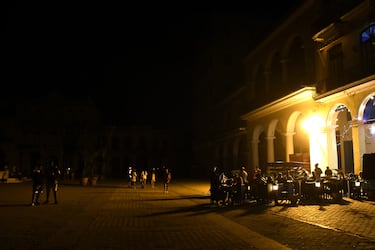
Little by little, tourists stopped coming, and with them, the dollars disappeared,” he told the BBC. “Old Havana is empty, completely empty. You walk around the places, and it seems like everything is dead.
Tour guides have no clients. I don’t know where tourism is. I don’t see it,” a French businessman who also preferred not to reveal his identity told the British network.
Another of the most affected places has been the island's main international destination, Varadero. Over the last decade, the Matanzas beach resort prided itself on receiving more than a million travelers annually, but that figure has drastically reduced. Today, it faces a 70% decline, a figure that many workers in the sector never imagined experiencing, local media 14ymedio points out.
“Varadero is chaos right now,” says a worker at the Los Delfines hotel. Beatriz, a Spanish tourist who has been returning to Varadero for ten years, has also witnessed the crisis hitting the island. “I knew the situation was difficult, but I didn’t think it was this bad,” she comments.
Bea, as the workers at the Cuatro Palmas hotel call her, considers herself almost part of the family in Varadero, as she has returned year after year. “This beach is the best in the world, but the situation has become unsustainable. The electricity goes out too often, and I have had to bring eggs from Spain,” she comments with frustration.