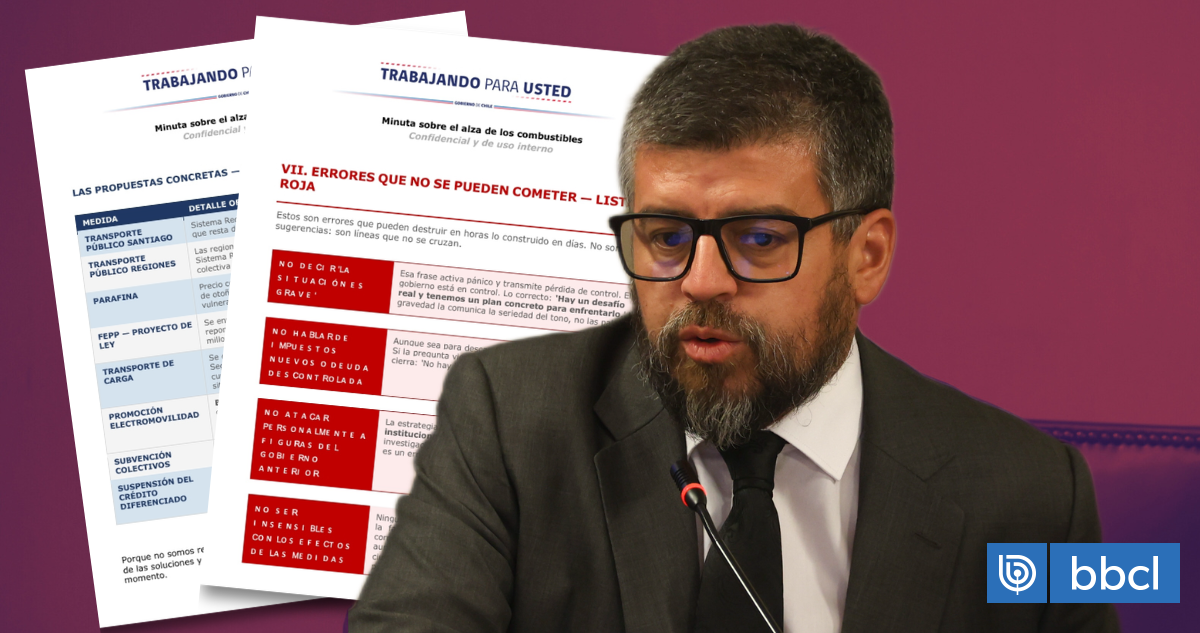
The deputy Ind-PPD Jaime Araya leaked a confidential government memo detailing the communication strategy to address the crisis caused by the rise in fuel prices announced by the Executive itself. The parliamentarian shared the document on his X account and launched harsh criticisms against the administration. “Go read the memo of lies that the government wants to install,” Araya wrote on the social network.
He accompanied his message with images of the internal document, which, according to sources from La Radio, circulated among government officials to unify the official discourse in response to the historic increase in gasoline and diesel prices. In his post, Deputy Araya questioned the Executive's priorities. “Can one be more frivolous?
Thinking of installing a narrative while they are putting a bomb on the budget of middle-class families, they are only interested in political gains; their mask has fallen,” wrote Araya, adding the hashtag “Resignation” directed at the government's chief political advisor, Cristián Valenzuela. The leak occurs amid the tension generated by the announcement of a $370 increase per liter in 93-octane gasoline and $580 in diesel, a measure that will take effect this Thursday. The leaked memo, titled “Memo on the Rise in Fuel Prices” and marked “confidential and for internal use,” outlines the guidelines the government seeks to establish in the public debate.
According to the text, the official narrative should rest on two pillars: an international crisis caused by war and a serious fiscal legacy received from the previous administration. “There is a war. A war that no one asked for.
A war that started far away but this week reached the gas pump of every Chilean,” the document states at its opening. S…
Absorbing the full increase would have cost up to $4 billion, resources that, according to the text, do not exist due to the increase in public debt by $40 billion over the past four years. One section is the so-called “red list,” which enumerates the mistakes that spokespersons must avoid. Among them, it prohibits saying “the situation is serious,” a phrase that according to the document “activates panic and conveys a loss of control.
” Instead, authorities are instructed to assert that “there is a real challenge and we have a concrete plan. ” The document also prohibits mentioning new taxes or uncontrolled debt, even to dismiss them, as it “installs fear. ” If the question arises, the response must be a single sentence: “There are no new taxes.
End. ” Another non-negotiable line presented in the memo is not to personally attack figures from the previous government, limiting comments to data and institutional responsibility to avoid potential defamation. The other focus of the memo regarding the rise in fuel prices: anticipating criticism The leaked document also contains a section on “anticipating opposition criticism,” where responses are prepared for expected questions.
In response to the accusation that the government “applies fiscal discipline at the expense of the middle class,” the memo instructs to reply that “the government that truly cut was the one that emptied the FEPP. ” If the government's preparedness is questioned, the text suggests not to become defensive and to attack positively with concepts such as “speed of reaction, clarity of diagnosis, executive decision. ” It also warns that “the own narrative must arrive before the hostile question.
” The memo establishes differentiated rules for government spokespersons and the ruling party's bench. While the former are instructed to “talk about solutions, never about blame” and to use the word “Together” in all communication, the ruling party parliamentarians are assigned the role of “talking about responsibilities” and accompanying each accusation with a concrete figure. The suggested closing by the internal memo in response to the rise in fuel prices is emphatic: “Neither a distant war nor a fiscally broken state due to poor management will stop Chile.
Together, Chile moves forward.