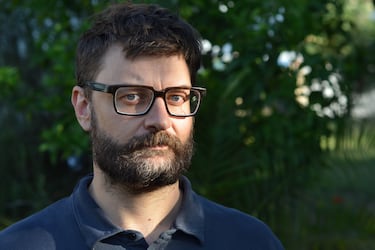
At one point in his life, around 2016, the Cordoban Federico Falco was living in Buenos Aires. He had published a novel and four volumes of short stories, but settled in the city of fury, he began to create something. “At first, for a while, I worked at Entropía, a publishing house in Buenos Aires, and then I started coordinating writing workshops.
At that time, if I remember correctly, I used the mornings to write, which is somewhat what I still do now, and in the afternoons I had work commitments. ” With that discipline, Falco shaped five long stories, mini novels in the style of the famous John Cheever. In 2016, he published them with the independent label Eterna Cadencia under the title "A Perfect Cemetery," and they were very well received.
Ten years later, with more experience under his belt, having been a finalist for the Herralde Prize for Novel in 2020 and won the Fundación Medifé-Filba Prize in 2021, the book is back in circulation, this time under the Anagrama label. "A Perfect Cemetery" gathers stories that are mostly set in rural Argentina. They unfold gradually, immersing the reader in the story from the beginning.
“It’s always strange to reconnect with who you were. It’s like reading about a person who is you and at the same time is no longer you. The book originally came out in 2016, but several of the stories were a bit older.
I am quite slow at writing, so there are stories from 2014 or even much earlier. It’s like a kind of excursion into the…
Is that search a metaphor for your own writing process? “I don’t know if I thought about it in relation to the writing process. In that story, the initial spark had to do with the treatment of the landscape, with how we modify the landscape to try to make it perfect, very much in quotes, for a certain aesthetic, for an idea of beauty that is often not found in nature.
I was thinking about that logic of a certain idyllic return to nature that, for example, gated communities promised, moving to live in closed neighborhoods and having a control over the landscape that somehow made it more pleasant. I believe that nature itself is not necessarily pleasant. I think at that time I was very interested in those discourses that created a certain myth of the natural, packaging it in a kind of formal package, all very orderly, all very perfect.
And I was interested in placing a character to deal with that, with that search for perfection. I was interested in putting the character in that kind of somewhat impossible task. That search for perfection can also be seen as a pursuit that hinders the creative process, the writing; that reading can be there, but originally it had to do with how we relate to nature.
” Many of the stories are set in small towns in the interior. What narratively interests you about those towns and their communities? “That is the answer I have never been able to fully articulate.
What happens to me is that I find it very difficult to write about cities. They do not generate a desire to write. I think there is something about village life that marks me a lot because I was born in a village and lived until I was 18 in a village, and now I live in a village, and village life allows stories to circulate more easily, and that attracts me.
In urban life, there are surely many stories circulating all the time, but I find it harder to move in that world. So, the answer is extremely subjective. There is no reason beyond my own inability to tackle urban stories.
That said, I believe that in towns there is still this idea of narrating, of telling stories. Lives unfold, and we can see them spread over time, marked by certain milestones, and for better or worse, the community is aware of that story and repeats and reproduces it. ” Faith is a theme in one of the stories, "Silvi and the Dark Night," about a girl who falls in love with a Mormon.
How did it come about? “It’s a very long story. Originally, a friend told me the anecdote of a crush she had on a Mormon missionary when she was a teenager.
Then the story changed a lot, went through many versions, and the plot went in another direction, but that was the initial spark. And what is your relationship with faith? “I always believe that to enjoy reading a work of fiction, we need to believe.
There is an act of suspension of disbelief and accepting the more or less rough rules that that world proposes, accepting them without questioning them, to enjoy the book. So, I think a good part of a writer's task is to make the reader believe you. And a good part of each reader's task, or at least my task as a reader, is to believe and not question.
” In another realm, how do you see Argentina under Milei's government? “I don’t know; I think it’s a very particular moment where we have already lost the capacity for astonishment. Personally, I experience it from a place of not understanding what is happening.
I try to stay informed, and at the same time, I don’t understand why the glacier law is being repealed, or why the workday is being extended. At what point did it become something we had to discuss again? And that it could be modified without too much uproar from the other side.
I think there is a erasure of certain codes, and above all, there is no repercussion. Personally, I feel that there is something about the government’s communication strategy that has to do with this kind of constant bombardment. Every week something is happening, every week something is falling, and that also becomes overwhelming at some point, so suddenly, you can’t react to everything.
You also need time to live, to build enjoyment, to build your own life, to preserve vitality.