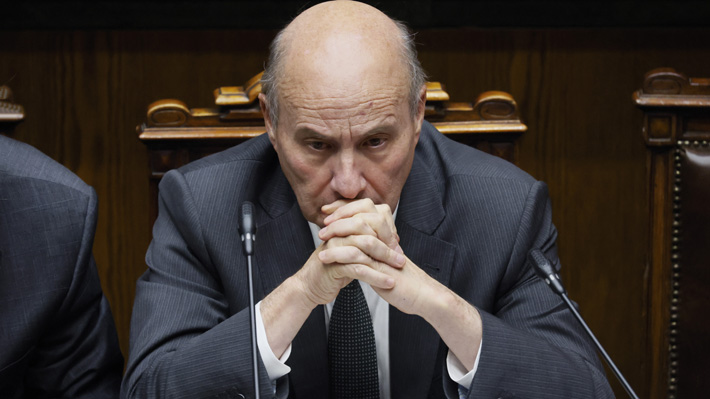
In a tense political scenario, Finance Minister Jorge Quiroz navigates the aftermath of the Mepco adjustments that triggered a historic rise in fuel prices in Chile, directly impacting citizens amid the oil shock from the war in the Middle East. The unprecedented increase of $372 in 93-octane gasoline, $391 in 97-octane gasoline, and $580 in diesel has caused discomfort at various levels: from consumers and different productive sectors to within the government itself. The decision—defended by the Executive as inevitable due to the high fiscal cost of Mepco in a context of inherited tightness—will have immediate inflationary effects and will hit economic activity.
In the Monetary Policy Report (IPoM) published this week, the Central Bank cut its GDP growth projection for 2026 to a range of 1. 5% to 2. 5%, down from the previously estimated 2% to 3%.
The issuing institute attributed this adjustment to a more adverse external scenario—marked by international conflict—along with lower internal impulses, such as the fiscal cuts announced by José Antonio Kast's administration and weak mining performance. All of this occurs within a complex inflationary framework. The issuing institute warned that inflation will see a "significant" rebound in the short term, driven by rising energy costs.
According to the IPoM, the CPI "would be around 4% annually starting in the second quarter of this year," incorporating the recent announced increases in gasoline and diesel prices. To mitigate the effects of rising fuel prices on citizens, Congress quickly passed a government-initiated law that includes measures such as freezing the price of kerosene and a monthly bonus of $100,000 for taxi, collective, and school transport owners. However, many voices have joined the political chorus pointing to the "insufficiency" of these aids.
All of this comes ahead of the government's presentation in April of a robust "National Reconstruction" project that con…
Tomás Izquierdo, economist and general manager of Gemines Consultores, told Emol that "the government has started its economic management very frontally, in order to advance in its goal of consolidating fiscal figures. In this context, the shock of oil prices and their derivatives has helped reinforce the emergency narrative. " A similar view, albeit with nuances, was expressed by Cecilia Cifuentes, economist and director of the Financial Studies Center at ESE Business School, who noted that "the first signals were positive in terms of evaluating projects, generating a certain climate of confidence at the outset regarding the government's commitment to push its investment agenda.
" However, she warned that the scenario changed abruptly. "The problem is that we had this so-called Black Swan, which was the war in Iran, and that raised the question of whether it was justifiable to subsidize fuels for an extended period. " From another perspective, Alejandro Weber, former Undersecretary of Finance and dean of the Faculty of Economics, Business, and Government at USS, stated that "it has clearly been a very difficult start, forced by two unanticipated crises, one inherited and the other international: the tightness of public finances and the oil crisis.
" Meanwhile, Macarena García, senior economist at Libertad y Desarrollo, indicated to Emol that "the government began its term with a very difficult economic situation to face (war)," emphasizing that the decision to pass on the fuel price increase was appropriate given the limited fiscal leeway. A more optimistic view was provided by UCLA economist Sebastián Edwards, who told El Mercurio that "a solid start... they came out like a racehorse, at full gallop.
And that is what is needed. " In the same vein, former Finance Minister Felipe Larraín said on T13 Radio that "this is not a local issue (increase in fuel prices); it is an external issue, but people still feel it in their pockets. Will they feel it?
Of course. Will it have political costs? Certainly, it will have political costs for the approval of a government that, in my opinion, started quite well.
It has started quite well. " Measures Under Debate: Investment, Permitting, and Fiscal Adjustment Beyond the diagnosis, experts agree that the challenge now is to activate measures that allow for the recovery of growth without exacerbating the already tight fiscal scenario. Izquierdo emphasized that "it is important to quickly advance initiatives that encourage investment, employment, and economic growth, so as not to negatively impact activity too much," adding that "it is very relevant now, as soon as possible, to push hard on the pro-investment agenda.
" In this line, Cifuentes underscored the importance of unlocking projects: "That has to be the strongest focus, and I believe it is even more relevant than the tax issue; it is effectively facilitating the investment processes of medium, large, and small companies. " Weber, meanwhile, pointed to a broader approach that combines incentives with fiscal discipline: "To recover activity, the plan is known: well-placed incentives and regaining trust," while emphasizing the need to reduce public spending and advance structural reforms. "Modernize the state, reduce permitting, provide legal certainty, promote employment formalization," Macarena García, senior economist at Libertad y Desarrollo, stated.
She added that "it is a good time to introduce the necessary modifications to achieve a tax system that provides adequate resources without generating distortions. The sooner these adjustments are applied, the faster people will see their benefits.