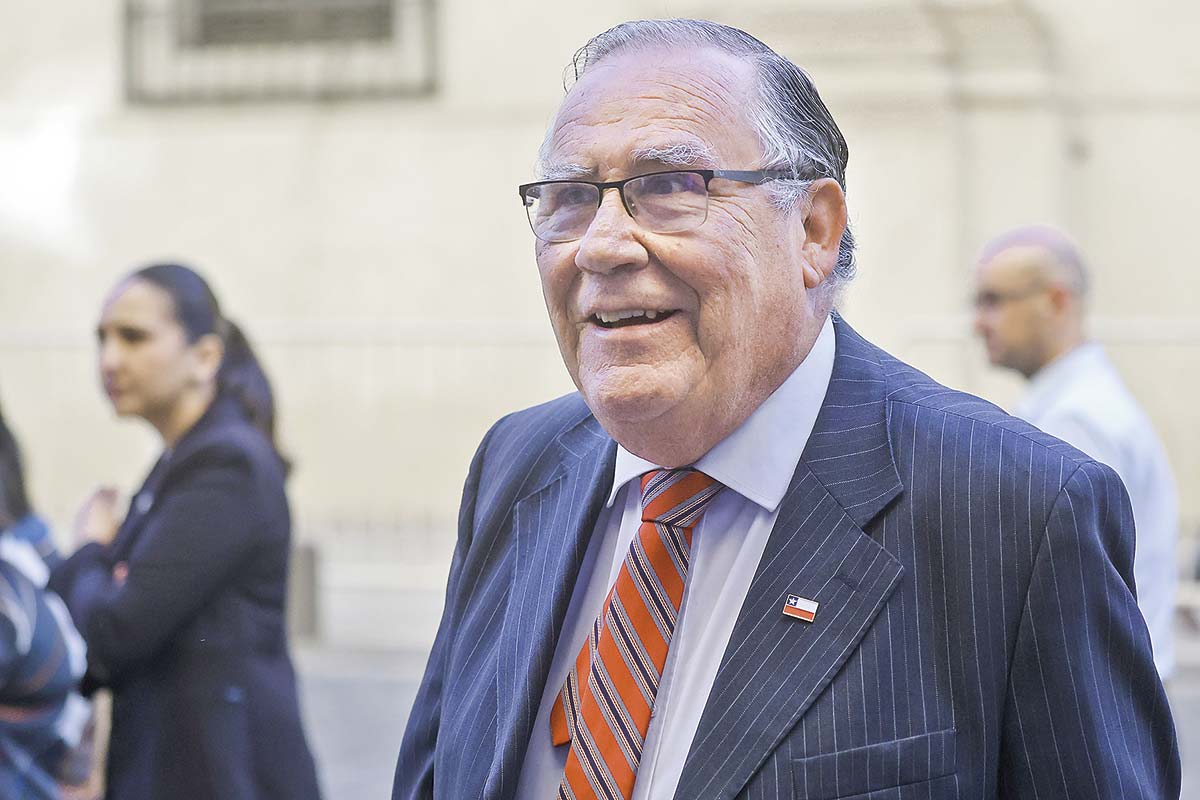
The debut of the Minister of Agriculture before the relevant Commission in the Chamber was filled with announcements, guidelines for his management, and memorable phrases, all very much in the style of the historic radical Jaime Campos, who returned to lead the agricultural portfolio exactly 20 years after holding the same position during President Ricardo Lagos's government. For an hour, the 73-year-old lawyer diagnosed that the sector "is going through a complex situation due to elements that condition the activity," such as the water crisis, financing problems, increased regulatory demands, and high levels of insecurity. "As the days have gone by, I must confess that I have found a sector and a ministry very different from what I knew.
The idea I had of what my work should be is conditioned by factors I was not so aware of," he told the deputies, setting out a series of "strategic axes that should characterize my management. " Firstly, he committed to strengthening all public institutions linked to the silvoagricultural sector, but particularly focused on the Agricultural and Livestock Service (SAG). "I arrive at the ministry and find myself in a situation of fiscal tightness that, I promise you, I never imagined would be of this magnitude.
" "Our phytosanitary heritage is the pillar on which the implementation of the entire agro-export development model rests, and if that comparative advantage we have is reduced, excuse me, everything we can talk about in terms of sectoral development disappears and ceases to be valid. " Immediately after, Campos surprised by revealing that "with the President, we agreed, given the importance and role that SAG plays, that our national director will be appointed directly by the President and not through the High Public Management competition systems. We are already implementing the decrees that point in that direction, and it will be the only service in the ministry that will have 'silver bullet' status.
" Sources familiar with the process told DF that the name to lead SAG is already decided and would be a well-known figure in the sector: Domingo Rojas Philippi, an agronomist from PUC who worked in the service during Sebastián Piñera's second government. Axes and Review of Free Trade Agreements In a second priority axis, Campos highlighted the deepening of the country's irrigation policy, an item that will work hand in hand with the Ministry of Public Works (MOP), to especially support medium-sized agriculture. On the other hand, he announced that "we are going to promote a new forestry promotion law in Chile, but according to the current reality.
Perhaps it will no longer be about thinking only of pines and eucalyptus as might have been the response in the '60s, bu…
" Nevertheless, he stated that most of Chile's free trade agreements were signed 20-25 years ago and that, as the world "has changed dramatically," "we are in discussions with the Foreign Ministry and the General Economic Directorate to take a pause and review these agreements. What is good will be maintained, but if there are adjustments needed in commercial and phytosanitary matters, they must be made. " Situation of the Ministry "I arrive at the ministry and find a fiscal tightness that I never imagined would be of this magnitude," said Campos.
In this regard, he warned that the 2026 budget of $1 billion (about $917 billion) was cut by $6 billion in January. Not only that, but the portfolio also includes postponed payments of $3. 258 billion from 2025, totaling $10 billion less.
Additionally, there is a further 3% adjustment requested by the Treasury, equivalent to about $30 billion. "We are going to experience a very, very restrictive situation from a fiscal perspective," said Campos.