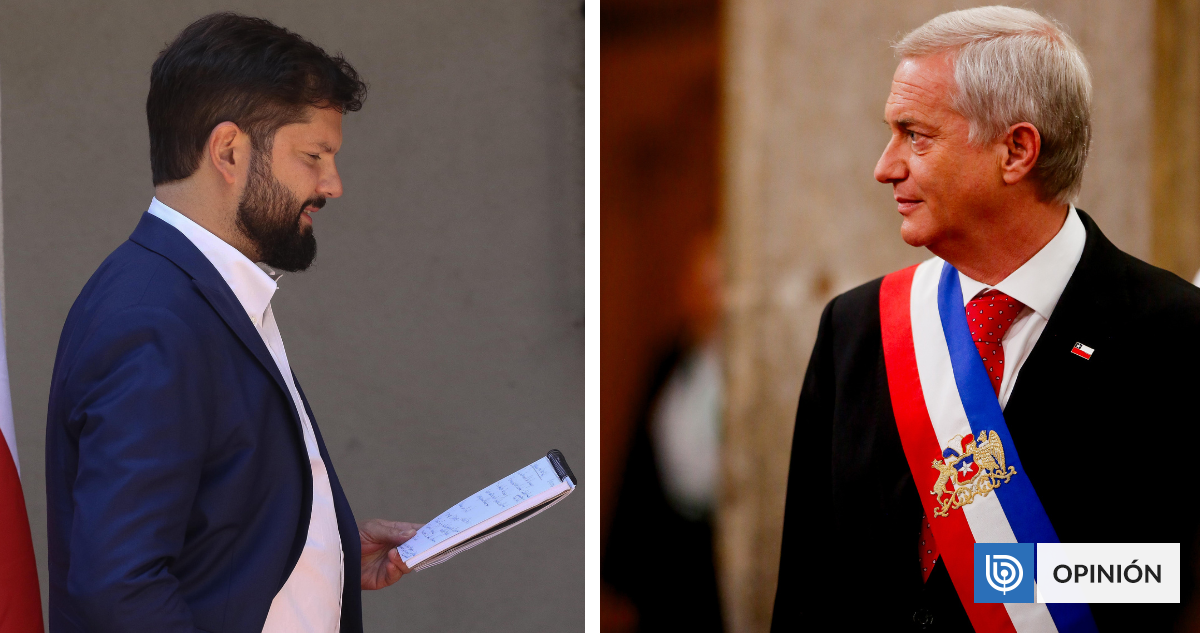
A theory as elegant as it is false is circulating on social media: that José Antonio Kast and Gabriel Boric have agreed on a transition where one halts audits in exchange for the other keeping the streets calm. This thesis is appealing because it organizes chaos, which is why it has been repeated by some journalists. However, it is false for a simpler reason: former President Boric and no political actor have total control over the streets.
Furthermore, it omits a key fact: it is also unsustainable for Kast's government to fail to fulfill its own campaign promise of auditing every position in the State. His narrative was built precisely on the contrast between efficiency and a previous government perceived as slow; renouncing that would not be pragmatism, but would undermine his own mandate. However, there is a primary risk that unrest may arise.
Not because of Darwin's frog or the 3% budget cuts, but due to the cost of living. The government decided to take on the political cost of raising fuel prices by adjusting the Mepco, with increases that could reach $350 per liter. Minister Quiroz presented it as a measure within his strategy to reduce expenses, as the mechanism costs around $200 million weekly and has become unsustainable.
The Finance Minister's statement is brutally honest: he is not there to be popular. He is there to manage the accounts and has said he will take painful measures. Often, in many governments, increases in fares, education costs, health care, or fuel tend to precede disorder in the streets.
The government itself recognizes this. It knows that the measure could trigger mobilizations—particularly from transpor…
In other words, cushion the impact, not avoid it. But here lies the underlying dilemma, the one that truly matters: what will the government do if the streets become chaotic? This is not a theoretical question.
It is the central question of the post-2019 political cycle. Because the problem is not just economic; it is about governability. Raising fuel prices is a technical decision; managing its consequences is a political decision.
It is important to remember that many of those who supported the current President were critical of Piñera for being too lenient or for handing the constitution to the violent. Therefore, it is impossible to think of a transaction of that kind. This is where comparative experience offers an uncomfortable clue.
Neither in Argentina with Javier Milei nor in Italy with Giorgia Meloni did the widespread explosion that many anticipated occur in response to tough measures. Not because there were no costs in people's lives, but because they managed to establish a key idea: they were fulfilling what they promised. Because of this, the adjustment was temporary, as a better time would come afterward.
Milei did not avoid the adjustment; he executed it coherently with his program, managing to at least stabilize inflation expectations. Meloni did not completely resolve immigration issues; but she conveyed control and direction on a topic where she had promised to act. In both cases, legitimacy did not come from leniency, but from consistency.
The streets tolerate more than is believed, as long as they perceive a sense. There is also the phenomenon that the right operates as in Peaky Blinders: characters who returned from war but could not escape it. Every economic decision is measured not only by its impact but by its potential to ignite unrest.
Every increase is evaluated with the question that has lingered since 2019: what if this ignites? Therefore, the only possible measure that must be swift is to maintain popularity by fulfilling what was a campaign narrative: the immediate expulsion of illegal immigrants and control of dangerous neighborhoods. Only then will activists be on the streets and no one else, as happened in Argentina.
Thus, the adjustment to the Mepco requires greater scrutiny; what is at stake is the first real test of the government. Not in technical terms, but in political ones, as the question is whether it will be able to sustain unpopular decisions without losing control of the narrative or legitimacy with the citizenry. The previous government of Gabriel Boric experienced a significant drop in approval when it decided to oppose the fifth withdrawal from the AFP, precisely because, even though it was a fiscally correct decision, it clashed with the immediate expectations of the population.
It also faced the difficulty that the authorities at that time, when they were deputies, fervently supported the previous withdrawals, making it harder to explain this decision. That is the structural risk: when economic policy is perceived as necessary but disconnected from everyday experience, legitimacy erodes rapidly. The difference, and the opportunity, is that today the government has an explicit mandate for order and efficiency.
If it manages to make the adjustment understood as part of that mandate and also fulfills the main promise that those who did not leave with all their belongings will be expelled with what they have, the streets may not become dangerous. If it fails to do so, then it will not be the price of fuel that determines the course of events, but the perception that the government has ceased to be coherent with what it promised.