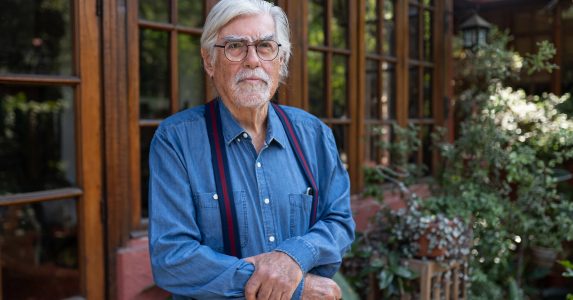
José Bengoa Cabello, anthropologist and historian, National Prize for Humanities and Social Sciences 2025, former rector of the Universidad Academia de Humanismo Cristiano, friend and collaborator of Le Monde Diplomatique, passed away in his home in Ñuñoa at the age of 81. Our heartfelt condolences to his wife Ximena Valdés, his children Ana and Simón, and all his family and friends. The unfinished dialogue with the land and memory.
Obituary of José Bengoa By Álvaro Ramis* With the death of José Bengoa, it is now said from all cultural fronts that an era has ended. But depending on who speaks, what is being bid farewell is something very different. Those who never saw in him more than a disturbing anthropologist, too committed to indigenous and peasant causes, now lament the disappearance of the last great organic intellectual, as if with him the figure of the thinker rooted in reality were extinguished forever.
Others, on the other hand, believe that his death marks the end of a certain way of making history, one that dared to place the defeated, the landless, and those whom official historiography had condemned to silence at the center. Political commentators, for their part, sense with relief that his passing closes a troubling cycle, one in which academia and activism could inhabit the same body without it seeming scandalous. A brutal fact, death, and so many opportunistic invocations of an end of an era that actually conceal the only thing truly at stake: with José Bengoa disappears the most radical of Chilean intellectuals of the last half-century, but what is at risk is not the prestige of national anthropology nor the memory of agrarian reform, but the continuity of a certain way of listening: the one that learned to make those condemned to mutism speak.
It was the Mapuche world itself, with its loncos and communities, that very early recognized in Bengoa an heir to its own memory. Not because he was born in those lands or because he carried their blood, but because he knew how to turn listening into a method and writing into restitution. Unlike ethnographers who arrived with pre-established categories, Bengoa was trained in the traditions of social history and the philosophy of liberation, but it was that encounter with the survivors of dispossession that revealed to him the task of his life: to make academia a place from which the word could be returned to those who had also been dispossessed of their past.
As the Mapuche leaders saw in this young anthropologist, who came from Valparaíso, someone who would not limit himself t…
Bengoa found his answer in a double movement that never ceased to tension him: on one side, the legacy of French social historiography and critical Marxism, which taught him to see structures, classes, and long durations; on the other, ethnographic listening, immersion in communities, the commitment to an anthropology that could not renounce the voice of the other without betraying itself. This tension between structure and event, between historical law and singular voice, gave his writing that characteristic quality: an erudition that never disregards concrete suffering. In "Historia del pueblo mapuche," published in 1985 during the dictatorship, he achieved a masterful first balance.
There, for the first time, the history of Chile ceased to be narrated from the centers of power to be reconstructed from the margins of resistance. The book was both a rigorous work of social history and an act of symbolic justice. Bengoa showed how Chilean modernity had been built on the systematic exclusion of those who, however, had been central protagonists of its territory.
But if in that inaugural work the pendulum still leaned towards the recovery of historical agency, in the following years, with "Historia social de la agricultura chilena" (1991) and especially with "La emergencia indígena en América Latina" (2000), Bengoa emphasized the other pole: the need to understand the structural limits that any emancipatory action must face. It was then that the legacy of Marxist criticism, filtered through the cultural turn, allowed him to show how capitalism had transformed peasant relations and how indigenous movements were not merely remnants of the past but a modern response to the coloniality of the present. But the true turning point, the one that would mark his maturity, occurred in the last decade of his life.
Bengoa undertook a return to more direct, almost oral narrative forms in his "Crónicas de la Araucanía" (2019) and later in "Crónicas Amerindias" (2024). There, the tension between structure and voice was resolved in a new way: not through theory but through chronicle, not through concept but through scene. As if he had come to the conviction that the dialogue with his own—peasants, Mapuche, the poor of the south—ultimately required shedding academic mediations to embrace the oldest form of knowledge: storytelling.
In that final phase, Bengoa seemed to tell us that all theory had been merely a prelude to learning how to tell a story well, so that those who had lived it could recognize themselves in it without the shame of being translated by another. It was also in those years that he deepened his relationship with the Escuela Campesina de Curaco de Vélez in Chiloé, as if retirement had returned to him the need to be in the territory, to share the table and the word with those who had never set foot in a university. There, far from the spotlight, he completed his most intimate work: that of training new generations of peasants who learned to tell their own story.
But long before, Bengoa had fought that battle as rector of the Universidad Academia de Humanismo Cristiano, an institution that embodies precisely that commitment to situated knowledge, engaged with popular sectors and open to critical social sciences. In our educational institution, he not only trained dozens of anthropologists who now work in indigenous territories but also built a space where the university ceased to be an enclave to become a bridge: between academic knowledge and popular memory, between theory and the practice of liberation. Those who knew him know that Bengoa maintained until the end an unfinished dialogue with two absent interlocutors: on one side, with the loncos who had initiated him into the knowledge of Mapuche history; on the other, with the figure of historian Mario Góngora, whom he admired and fought at the same time, because he represented the temptation of a seamless national history, without the concrete faces of the defeated.
That dialogue with the adversary master was the secret engine of his work: the need to show that the history of Chile could not be written without including dispossession as a central thread, but also without falling into the epic of victimization. His bet was more difficult: to show that indigenous and peasant peoples had been, despite everything, subjects of their own history. The intellectual tragedy of his death is that this dialogue is now truncated.
In his last years, Bengoa had returned to question the place of the peasantry in present-day Chile, the relationship between indigenous autonomy and national project, the need for a new agrarian reform that this time would start from memory and not just from the economy. These were questions he left us as a task. With him, certainly, goes a way of understanding intellectuality: not as the priesthood of pure ideas, but as the craft of putting knowledge at the service of those who have never had a voice.
But what is truly at stake with his death is the continuity of that gesture, so fragile and so necessary, which consists of believing that the university can rise to the level of the land, that theory can take on pain without betraying it, that history can finally be written as a debt. Someone once said, when bidding farewell to a teacher, that with his death one is left, intellectually, completely naked. How many more reasons do we have to say it today, those of us who still try to think from the south, with peasant memory and indigenous voice still resonating in the territories that Bengoa inhabited.
Because if there is one thing he taught us, it is that thinking is nothing more than learning to listen. And now, with him, listening becomes more difficult. But also, perhaps, more urgent.