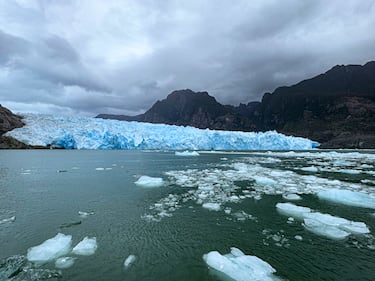
At the top of the mountain range or deep within the white continent, glaciers have functioned for millennia as a silent archive of the planet. Each layer of ice contains a story: particles of dust, volcanic ash, traces of wildfires, and, above all, air bubbles that encapsulate the composition of the atmosphere from another era. These records have allowed science to reconstruct what the climate was like thousands of years ago.
However, this unique and irreplaceable natural archive is at risk. In Chile, the latest Public Glacier Inventory, conducted by the DGA, identified 26,180 glaciers in the continental territory, covering more than 21,000 square kilometers, equivalent to 2. 79% of the country.
The figure, however, holds a paradox: while there are more glaciers than in the 2014 inventory, they contain less ice. The explanation lies in fragmentation. Large glacial masses have divided into smaller bodies, which increases the total number but evidences a sustained loss of surface area, volume, and water reserves.
And, with this, experts warn, not only is ice lost: a historical record of the climate also fades away. “Glaciers can testify to what the climate was like up to 12,000 years ago in the continental territory,” explains climatologist Raúl Cordero from the University of Santiago. The logic appears simple: the snow that falls accumulates layer upon layer, and over time, pressure transforms that snow into ice.
In this process, air bubbles are trapped, preserving the atmospheric composition of the moment they formed. By drilling…
“It is possible to reconstruct how the composition of the air has evolved and, therefore, the climate,” adds Cordero. In Antarctica, this archive reaches scales that are difficult to dimension. The ice can contain information from up to 800,000 years ago and even more in future explorations.
There, the so-called Antarctic Peninsula glacial complex, covering more than 80,000 square kilometers, constitutes one of the largest reservoirs of climate information on the planet. However, this archive has increasing fragility. “As glaciers are melting and could disappear in a few decades, there is a race to extract samples before that happens,” warns Cordero.
The international scientific community has promoted projects to collect and preserve ice cores, aware that their loss would be irreversible and that researchers of future generations will not have the natural testimony of the climate as it has passed through time. Glaciologist and researcher at the Andrés Bello University, Francisco Fernandoy, describes the process as a sort of “cookie cutter” in a millennia-old cake. Through mechanical drilling, cylinders of ice are extracted that contain not only frozen water but also impurities and trapped gases.
“We can analyze the isotopic composition of the water and determine whether the climate was colder or warmer, wetter or drier,” he details. But the information goes beyond temperature. These cores record signals of volcanic activity, particles from wildfires, and even traces of human action.
“In Antarctica, we have detected particles from fires in Patagonia. This speaks to how the atmosphere transports these signals on a continental scale,” adds the researcher. This level of detail makes glaciers an irreplaceable tool.
If they disappear, there is no way to replicate that record with the same precision. There are alternatives, such as sediment in rivers or lakes, but their temporal reach is more limited and their resolution lower. The problem is that glacial deterioration is neither linear nor uniform.
In most cases, glaciers are retreating: their fronts are receding as temperatures rise. But in others, like the Pío XI glacier in Patagonia, an apparently contradictory phenomenon occurs: the glacier advances. According to experts, this would not necessarily be a positive sign but rather an effect of global warming.
The ice flows faster, giving the impression of advancement, although it actually responds to an altered dynamic. “None of these things are good,” emphasizes Cordero. Meanwhile, extreme conditions hinder scientific work.
Fernandoy recounts that during a campaign in the Antarctic Peninsula in 2025, his team had to evacuate a camp due to the arrival of atmospheric rivers that brought warm air and humidity to the area. “These are signs that circulation patterns are changing,” he says. The urgency, then, is not only environmental but also heritage-related.
Each glacier that is lost implies the disappearance of a natural archive. Even if scientists manage to preserve samples, the complete context or the possibility of new techniques is reduced. In this sense, glaciers are more than water reserves or remote landscapes; they are libraries of the climate.
And, as with any historical archive, their destruction affects not only the present. The challenge is twofold. On one hand, mitigate climate change to halt the loss of glacial mass.
On the other, rescue as much information as possible before melting erases those traces. In this tension, glaciers become both witnesses and victims of the same process. An archive that is literally melting away.