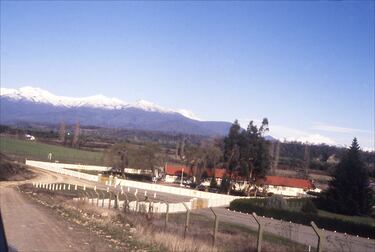
The Minister of Housing, in an interview with this media outlet, indicated that four projects approved during the previous administration will not move forward—projects that involve substantial resources—among them the expropriation of 117 hectares of the former Colonia Dignidad. This operation aimed to preserve extensive portions of land and housing from the enclave to be designated as spaces for memory, considering the grave history of human rights violations that took place there. The authority justified the decision mainly due to instructions from the Ministry of Finance for various ministerial portfolios to implement cuts equivalent to 3% of their budget, which will lead to the elimination of projects that are either not a priority or require large amounts of resources, thus allowing efforts to focus on the housing needs of the population.
The government has also pointed out that the Ministry lacks legal authority to expropriate for these purposes, an interpretation that has been outright dismissed by former authorities. The announcement has faced harsh criticism from the opposition, as well as from organizations linked to human rights, which accuse evident ideological motivations behind this decision, highlighting the grievance it poses for the victims and, of course, for the country to abandon the creation of a memory space in such an emblematic location as Colonia Dignidad. Furthermore, they have warned that the government's decision contravenes agreements that the state itself signed with Germany, where since 2017 a joint agenda has been developed to make the enclave a site of memory and documentation center, where the expropriation had already been included as part of what Chile offered.
Although thorough appraisals were not completed to determine the exact value that the expropriation of the 117 hectares would involve, there is no doubt that it would entail very substantial sums. Given the ominous tightness of fiscal resources, it seems difficult to reproach the government for seeking to prioritize the multiple demands for housing and reconstruction, which are very concrete aspirations of the population. Likewise, it cannot be attributed to ideological motivations, because the fact that such an expropriation does not take place in no way implies that the authority has closed the door to exploring other alternatives that honor the cause of human rights—such as a memorial, for example—but at a fiscal cost that the country can sustain.
Therefore, it is certainly abusive to try to instill the belief that seeking less burdensome alternatives and prioritizing public resources implies disregarding the victims or opposing the cause of human rights. Following the controversy generated, President José Antonio Kast himself responded, stating that the initiative can be limited to a place of reflection and meeting, while the Minister of the Interior suggested that "no one in the government opposes the construction of a memorial, and that a limited expropriation could be a formula. " These proposals could have been clearly articulated from the beginning as part of good communication management, which would have mitigated the impact of this decision.