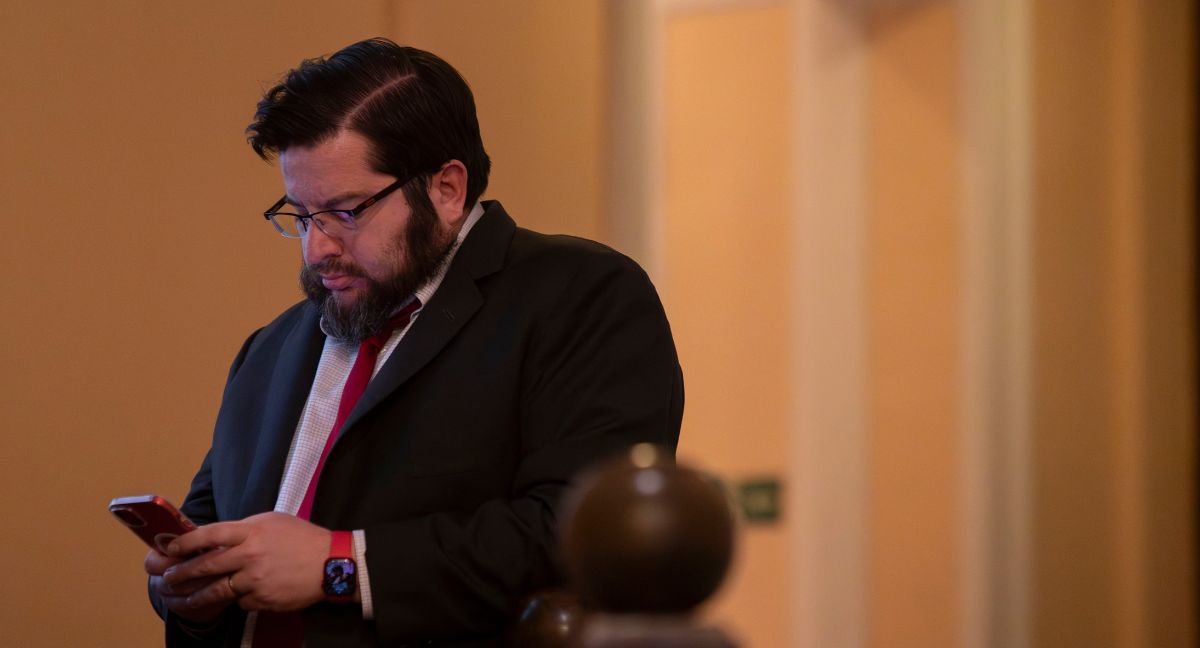
Filtered communication minutes, posts removed from the official Government social media, and a report from the Comptroller's Office regarding the controversial concept of "State in bankruptcy" are part of the aftermath of the recent debut of the Directorate of Communications and Content in the Second Floor of La Moneda. This body was created by the administration of President José Antonio Kast, under the leadership of Cristián Valenzuela, one of the President's main advisors. Throughout most of Wednesday, the Executive's communications focused on damage control after graphic and audiovisual materials—intended to explain the rise in fuel prices following changes to Mepco—stated that the State of Chile was "bankrupt.
" "I would never use the word that the State is bankrupt. What happens is that the State is in a deteriorated fiscal situation," said Finance Minister Jorge Quiroz bluntly when asked about the publications. These statements were supported by Interior Minister Claudio Alvarado, who also distanced himself from the concept.
"I think it's a more colloquial term, but ultimately it is a severe, tight fiscal situation," he clarified. Inside La Moneda, they admitted that it was a somewhat imprecise concept, as it implies serious economic implications, suggesting the country’s failure to meet monetary obligations. While they accused the opposition of taking advantage of a literal interpretation, the Executive conveyed that Valenzuela took direct responsibility for the publications.
This idea of a bankrupt country was not only disseminated through social media but also appeared in an internal and confidential memo for authorities, prepared by the Communications Secretariat (Secom), led by Felipe Costabal. The document affirmed the idea of a "bankrupt State" with a "completely empty treasury. " The controversy also opened a flank for institutional oversight after the Comptroller General of the Republic sent a letter to Segegob to gather information regarding the content of these communications.
"It is required to report on the public resources and personnel involved in the generation of these publications and, in…
I think the word is not the most fortunate," Costa stated after being questioned by lawmakers about the potential bankruptcy of the State. From populism to governmental communication It is worth mentioning that the uproar over rising gasoline prices and the Executive's communication errors occurs amid the so-called "agenda takeover," a strategy designed by the Second Floor of La Moneda, which has involved an intense deployment through the signing of decrees, sending of bills, digging in the north, environmental offensives, and withdrawing support for former President Michelle Bachelet's candidacy to the UN, among other issues. This planned architecture followed the victory in the second round, whose implementation depends on the new direction of communication and content, tasked with constructing the Government's narratives and translating current events into political terms without "intermediaries" in their language with citizens.
For this reason, the errors in design fall directly on Cristián Valenzuela, who exercises direct authority over Secom. According to Marcelo Santos, a Doctor in Communication Sciences and academic at UDP, the Executive's errors reflect an "adaptation process," stemming from a presidential campaign with "populist characteristics in communication" that now—while in power—must be subject to different levels of oversight. "I think it was even positive for the government that all this happened quickly, so they can calibrate their discourse.
Because the conflictual discourse, the populist discourse of empty ideas, of half-truths, which characterized the campaign, evidently generates legal problems when in Government," Santos said. The expert notes that the controversy translates into a "calibration" after "an aggressive campaign that was little concerned with the commitment to facts. " "Now they are obliged by the existing institutional framework to be more prudent and choose their words better.
That seems to me to speak very well of Chilean institutions, on one hand, because it quickly shows what the lines are that mark the field, and the team currently in government will have to learn quickly to play within that field," he emphasized. Interpellation of Sedini Another political angle is the interpellation announced by People’s Party deputy Zandra Parisi against the Minister of the General Secretariat of Government, Mara Sedini, to demand public explanations regarding the Government's communication content. "We are going to interpellate the minister spokesperson for the Government to come and explain what reasons she has to say that Chile is bankrupt," the parliamentarian stated.
Sedini's performance has already been criticized by members of the ruling party, who point out that her role has been limited to repeating the content of the Communications Secretariat's memos, lacking the political acumen to navigate the crisis. This fact would highlight a hermetic design from the Presidential team over Segegob. One of the most commented episodes this week was her participation this Tuesday in the morning show on Canal 13 where, according to sources from Chile Vamos, she failed to express herself clearly and made serious errors, such as stating that in Spain the price of a barrel of oil was two euros, when in reality it has been over 100 dollars.
Additionally, the push from Ind-PPD deputy Jaime Araya, who formally requested the head of the General Secretariat of Government to initiate an administrative inquiry and suspend the officials responsible for the leaked memo, which included the concept of a "bankrupt State," adds to the situation. "Hereby, I request that you proceed to instruct an Administrative Inquiry in the Communications Secretariat (SECOM), led by Mr. Felipe Costabal, and in the Directorate of Communications and Content of the Presidency, headed by Mr.
Cristián Valenzuela, regarding the preparation of a document titled 'Memo on the rise of fuel prices,' which contains guidelines directed at Government authorities concerning how to publicly address the rise in fuel prices," the letter states.