National Search Plan reveals that former landfill in Macul could hold remains of 30 disappeared detainees murdered during the dictatorship March 22, 2026 A shocking discovery in the Metropolitan Region provides new information for investigations into crimes committed during the dictatorship. A report from the National Search Plan (PNB), released by CIPER, indicates that an old landfill located near the intersection of Avenida Departamental and Macul could contain the remains of at least 30 disappeared detainees. The 33-page document was submitted at the end of February to the visiting minister of the Santiago Court of Appeals, Paola Plaza, who has been leading the investigation since 2022.
The analysis compiles testimonies, forensic records, and historical aerial images, forming a set of evidence that reinforces the hypothesis of illegal burials during the military dictatorship in Chile. The report asserts that the collected evidence is “multiple, convergent, and consistent,” allowing for the establishment of “the occurrence of repressive actions carried out by officials of Carabineros de Chile and the Chilean Army within the landfill following the military coup,” in addition to confirming “the existence of machinery (…) used to illegally bury a large number of corpses. ” For the preparation of the list of possible victims, the National Search Plan considered cases of individuals detained between September 1973 and early 1974 in the Metropolitan Region, for whom there is no information about their final fate.
Military trucks and bodies discarded One of the most significant accounts is from Marcelo Bustamante, who stated that he witnessed the arrival of military vehicles at the site. “We saw that several military trucks began to arrive… who started unloading a large number of bodies of different ages and sexes,” he reported to T13. This testimony is supported by evidence collected since the 1990s.
The report recalls that “both the National Commission on Truth and Reconciliation and the National Corporation for Reparations and Reconciliation received reports in the early 90s about the use of the area as a site for abandoning corpses. ” Other accounts reinforce this thesis. José Obreque stated that he and friends observed how “two or three soldiers took all the bodies that were lying on those avenues and loaded them into a military truck.
” Similarly, Víctor Flores recounted that “about twelve to fifteen bodies were found inside the Macul landfill. ” One of…
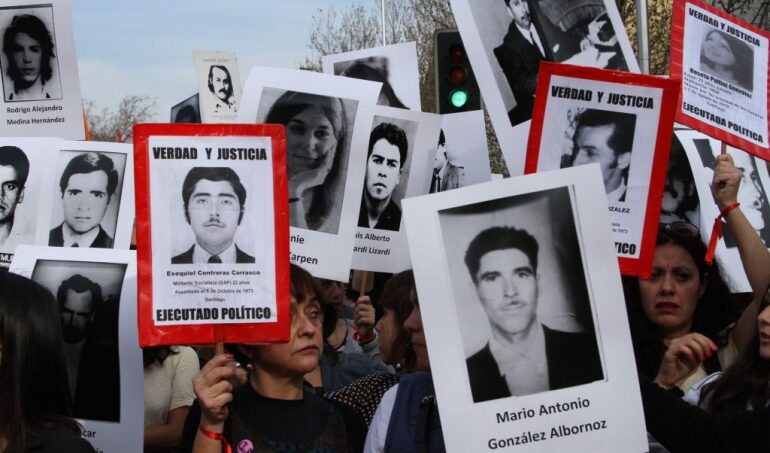
These are individuals detained in the early months following the coup, whose bodies have not been found. Additionally, the document notes that in previous judicial cases, remains had already been found in nearby areas, and records from the then Legal Medical Institute indicate that “at least eighteen corpses were found in public areas in the sector” between September and October 1973. Currently, the site corresponds to a vacant lot in an urban area, but in the 1970s it functioned as a landfill in a semi-rural environment.
The report establishes a priority search area near the former location of the Luxor nightclub.