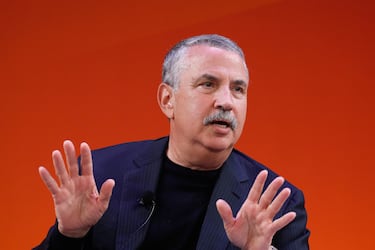
Few journalists know the Middle East like Thomas L. Friedman. A three-time Pulitzer Prize winner and influential columnist for The New York Times, he is one of the best "readers" of global trends and one of the most recognized political analysts worldwide.
The author of dozens of books, including The Lexus and the Olive Tree, he lives traveling and reporting on the ground. Between trips, he speaks with La Tercera via Zoom from his office in Washington, filled with books, documents, and materials he uses in his work. "This week, I suppose we are decapitating Cuba," he says, referring to the avalanche of events generated by the Trump administration.
"So it's hard for me to keep up," he admits. A few days ago, you wrote that Trump has no idea how to end the war in Iran. How can this conflict end?
This reminds me of a guy who stops a police officer and asks, "How do I get to Santiago? " And the officer replies, "Well, I wouldn't start from here. " But here is where we are...
I wouldn't have started from here: I wouldn't have initiated this war this way, at this moment. This is a total disaste…
Because in these situations, there is always the morning after... And the morning after the morning after, as you say, is how you have to look at these kinds of conflicts. Yes.
The morning after that, Iran declares victory. But the morning after the morning after, they have a big problem. They have a non-functioning economy.
They have a devastated army. They have wasted billions of dollars on a crazy project to try to acquire a nuclear weapon to destroy or threaten Israel. And eventually, the weight of that will be felt; people have no jobs, no income.
And I think that's the only way: these regimes do not change from the bottom up. Remember that Bashar al-Assad, the revolution in Syria, happened in 2011. It took at least six years to be overthrown.
And in the process, he killed 650,000 people and turned several million Syrians into refugees. So these transitions do not happen easily. But from that, a moment of transition has emerged in Syria.
And I think that's the best we can hope for. If there's anything I've learned from the wars in Iraq and Syria, it's that you cannot rush history. Trump thought he would have another Venezuela and another Delcy Rodríguez in Iran, but that didn't happen.
Why the miscalculation? What they have done by decapitating the Iranian leadership is that, at least from afar, it can be seen that all power has fallen into the hands of the Revolutionary Guard. So now they are in charge, basically.
And they always were, in a way, but there was a civil and clerical facade to this regime, while the Revolutionary Guard had the real power and control of the economy. Therefore, I would say whoever is leading the Revolutionary Guard, we don't know for sure, is the one running all of this now... Look, I’m 72 years old, and this morning I was thinking of asking Gemini Pro 3 two questions.
One: How many generations of Hamas leaders has Israel killed? And question number two: Who is in charge in Gaza today? What did it say?
It said: Hamas. So, if there is something that repeats, we have a very problematic partner in Netanyahu, because Netanyahu will never allow the United States to reap the benefits of any strategic or tactical victory in Iran. Why?
Because it doesn't advance anything with the Palestinians. And that's why he actually cannot take advantage of any of that: they have defeated Hamas, they have Lebanon and Syria, they could reach peace with Saudi Arabia, but he won't do it. He is a radical actor.
And his interests are not those of the U. S. government, nor those of American Jews, nor those of Jews worldwide.
He has a radical agenda to take over the West Bank. How many times does he have to tell us before we believe him? We are not aligned on this, and I have been trying to make that clear for a long time.
Now, this project to transform Iran, in general, is much more important than the left is willing to recognize. And it is much more difficult than the right is willing to recognize. How so?
Nothing would change the prospects of the Middle East more than a government in Iran dedicated to one thing: allowing Iranians to develop their full potential and create a more consensual government. Iran has been the greatest imperial power in the Middle East since 1979, with due respect to the Israeli occupation of the West Bank. Iran has been de facto occupying four other countries: Lebanon, Syria, Iraq, and Yemen, through proxy groups.
So we have to be realistic about this. Nothing would empower those countries to reach their full potential more than a weakening of the suffocating control that Iran has exercised over them. Just that weakening gave Lebanon the opportunity to have the best government since the civil war, and Syria the chance to have a different government.
So to say that everything is wrong, that everything is stupid... Look, I don't believe in war at all, I just say that this is a bad regime. And changing this regime would greatly help, first of all, to free the potential of the Persian people and their civilization, and then to improve the region.
It is not the only thing that would improve the region, but it is the most important. That said, it is enormously difficult. And the idea of simply bombing them from the air, and that people would go out into the streets and take control, was an incredibly naive idea.
And not only was it naive about the internal dynamics of Iran, but it completely underestimated that Iran has a say in this. And the regime has a vote. The enemy has a vote.
And the enemy voted to use the power of the weak. We use the power of the strong. We bombed everything we could see.
They responded with the power of the weak: two drones in the Strait of Hormuz. That was all it took: $20,000 each. Very effective...
Very effective. There are 600 ships trapped there. I feel very sorry; I cry for the forests that have been cut down to study what would happen if the Strait of Hormuz were closed for the global economy and the global energy economy.
I don't know how many people, how many doctoral theses have been written about that. And yet, our president chose to ignore them all and go with his instinct. How do you see the impact of this on the United Arab Emirates and Saudi Arabia, which were considered safer places and are now being attacked?
This is very sad. Basically, what you are seeing is the old Middle East, the Middle East of the resistance regimes —represented by Iran— trying to destroy the new Middle East, which is the Middle East of globalization, inclusion, diversity, and connection to the world. So you can mock Dubai all you want, but Dubai as a model has given more young Arabs the ability to develop their full potential on a global stage than ever before.
And it is not a democracy, but it is a very decent place. No, you cannot write an op-ed in the Wall Street Journal attacking the ruling family, but you can start a business and develop your full potential there, both as a local or as a foreigner. So Iran is trying to destroy that now to gain an advantage over us.
You said last year was one of the worst in your nearly 50 years as a journalist. How is this year shaping up? Well, I wrote that in the context of returning to Minnesota, my hometown, where the largest civic uprising in the name of democracy and the rule of law by people not in uniforms that I have seen in my life occurred.
So there are also other good trends happening, but basically, we have seen the complete rot of the American elite. Now we are governed by a technological oligarchy that is increasingly buying up media, pleasing people like Epstein, who appear in every one of your emails. And we really have to look in the mirror.
I don't know what happened to the law firms, the tech companies that kneel before Trump... They kneel before "King Trump," you have written... Yes, King Trump.
And I feel lucky: I work for a great family, the Sulzberger family, for a great newspaper, and they are not doing that, we are not doing that, and I am not doing that. Look, this is the fight of my life. And I am not tired...
The midterm elections in November are highly influential in all these matters. How do you see the Democrats' chances of regaining ground? It depends a lot on what happens, and that is totally unpredictable.
But the only thing I know is that Trump 1 was surrounded by barriers, but Trump 2 is surrounded by amplifiers. And that is the fundamental truth of the country right now, and I think that has gotten us into a lot of trouble. The importance of Democrats gaining the House of Representatives, at least the House, lies in that we will have protective mechanisms again.
Because Trump has had it all: the Supreme Court, the House of Representatives, the Senate, the White House, so he could act like a dictator in many ways. The courts have restrained him to some extent, but he could really do whatever he wanted. He could act like a king.
That is why it is so important to gain at least a lever of power. But we are in for tough years ahead. These are not normal times, and I just hope my country can survive the next three years.