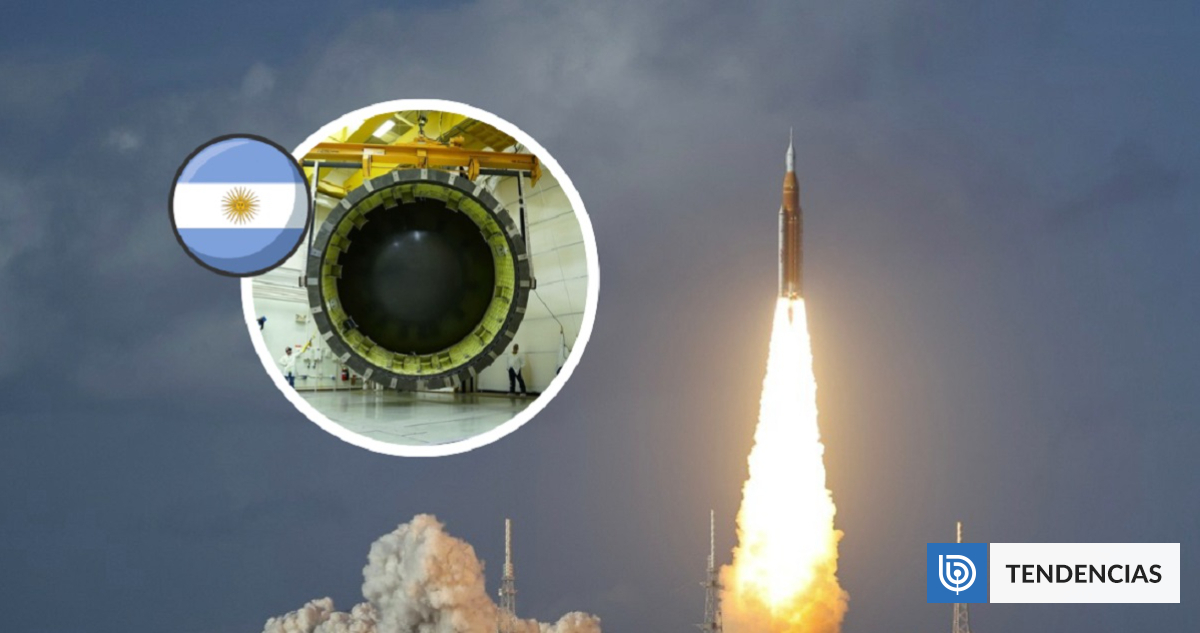
The return of humanity to the lunar environment with the Artemis II mission put the United States National Aeronautics and Space Administration (NASA) in the global spotlight this week. However, amidst technological giants and space powers, there was a noteworthy detail: Argentina is the only country in Latin America that managed to be part of this historic journey. The Artemis II mission, launched on Wednesday, April 1, from the Kennedy Space Center, marked the return to lunar orbit for the first time since Apollo 17, precisely 54 years ago.
An Argentine "DNA" satellite Onboard the Orion spacecraft was a secondary payload, a microsatellite developed entirely in Argentina, which was selected along with only three other countries: Germany, Saudi Arabia, and South Korea, after a competitive process involving over 50 proposals. This microsatellite, named Atenea, was developed by the National Commission on Space Activities (Conae) and represents years of public investment in science, technology, and space development, despite recent budget cuts during the Milei administration. Behind the project is a network that combines public agencies and the national scientific system, including the National University of La Plata (UNLP), the National University of San Martín (Unsam), the University of Buenos Aires (UBA), the Argentine Institute of Radio Astronomy, the National Atomic Energy Commission, and the company VENG.
The collaboration between public and private sectors met NASA's reliability standards for crewed missions, where the margin for error is virtually nonexistent. How does Atenea work? Atenea, deployed as a 12-unit CubeSat, is a compact satellite measuring 30 x 20 x 20 centimeters and weighing about 15 kilograms, but with an ambitious goal: to operate at approximately 70,000 kilometers from Earth, an unprecedented distance for Argentina.
From this orbit, Atenea will attempt to establish communication with ground stations located in Tolhuin, Tierra del Fuego, and in the province of Córdoba. If successful, it will mark the greatest transmission range achieved so far by an Argentine development. At the same time, it aims to measure radiation in different layers of space, examine how electronic components function under extreme conditions, and study navigation signals such as GPS, Glonass, and Galileo at less explored altitudes.
Construction of Atenea The technological development includes silicon photomultiplier sensors and a GNSS receiver for sa…
“We are proud that Argentina was the only country in Latin America invited by NASA to integrate a secondary payload in this mission, and one of the four countries selected globally,” declared Darío Genua, Secretary of Innovation, Science, and Technology of Argentina. “Each engineering project strengthens our technological capabilities, trains highly qualified resources, and makes us a reliable provider for the new space economy,” he emphasized while announcing the unprecedented launch. Why is the Artemis II mission so important even though astronauts will not touch lunar soil?
Regarding the Artemis II mission, it is worth noting that its success will be crucial to confirm the date of the anticipated crewed lunar landing, scheduled before 2028, according to U. S. calculations, as well as the establishment of a human colony on the Moon.
The administrator of the U. S. space agency, Jared Isaacman, recently announced a phased lunar deployment strategy, with a cost of $20 billion, which will be the most ambitious in five decades and will involve contributions from private companies like SpaceX and Blue Origin, as well as other international space agencies.
The new strategy will focus on ensuring that the United States can maintain a permanent presence on the lunar surface, and that in the third phase of the project, the base will have three habitats and obtain resources from the Moon itself. The first step has already been taken: astronauts Reid Wiseman, Victor Glover, Christina Koch, and Jeremy Hansen are projected into space on a trajectory of up to 9,200 kilometers beyond the Moon, surpassing the records set during the Apollo missions.