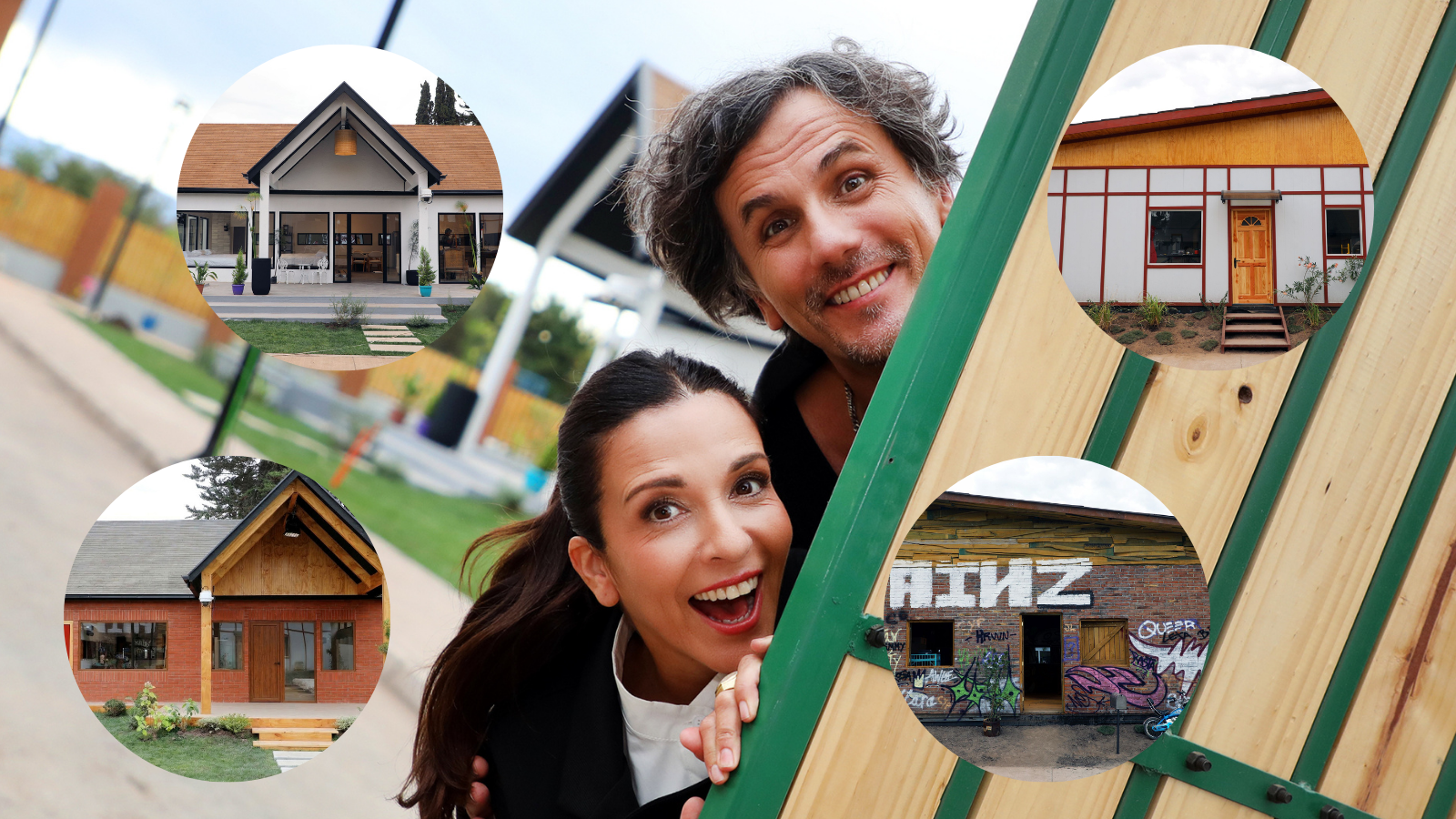
The new reality show on channel 13 bets on a key innovation: four completely different houses that reflect real living standards in a neighborhood. "Neighbors on the Edge," the new reality show hosted by Sergio Lagos and Karla Constant, takes place in a neighborhood built in Calera de Tango with four houses of varying levels of comfort, where 24 participants will live together based on their weekly performance. Under the slogan "A reality based on real facts," "Neighbors on the Edge" marks the return of reality shows filmed in Chile, following several productions made abroad.
But beyond its comeback, the program aims for an ambitious and differentiating proposal: the construction of a complete neighborhood as a narrative and competitive axis. The project, led by executive producer Marcos Gorbán along with Cooking Media, was set up on a plot of land in Calera de Tango, an emblematic location for this type of format, where previous shows like "Pelotón" and "Doble tentación" were developed. In just 90 days, a team of over 100 people constructed 2,200 square meters of real construction, including paved streets, sidewalks, lighting poles, a square, a community center, and, especially, four fully functional houses.
According to art director Matías Botto, this project marks a turning point in the production of reality shows in Chile. "It is the largest and most real project we have worked on. The execution was the closest to a real civil work, because we did not limit ourselves to building a television set, but aimed to create a true neighborhood," he details.
The use of solid materials like bricks and cement, instead of lightweight structures, allows participants to interact with a completely real environment, enhancing the level of immersion and the emotional impact of living together. Here are the four houses of "Neighbors on the Edge": The main differentiator of "Neighbors on the Edge" lies in its structure: 24 participants (8 celebrities and 16 unknowns) divided into four teams, who will be assigned to different houses each week based on their performance in competitions. These homes not only vary in aesthetics but also represent concrete levels of comfort and quality of life, becoming a direct engine of tensions, alliances, and conflicts.
Luxury House Those who achieve first place will access the Luxury House, the most privileged space in the neighborhood. …
Thematic House Second place will go to the Thematic House, a dynamic proposal that will change week by week. Its main characteristic is variability: - It can be favorable or uncomfortable - It will have special decorations and conditions - It will alter the routine of the team living there This house introduces a key factor in the reality show: unpredictability, forcing participants to constantly adapt and generating unique scenarios in each cycle. Basic House Third place will live in the Basic House, a space that covers basic needs but with significant demands.
Among its characteristics: - Aesthetics similar to a warehouse - Simple conditions, without luxuries - Total responsibility for cleaning and maintaining the neighborhood Those living in this house will not only have to coexist among themselves but also take an active role in the community, which can lead to physical and emotional exhaustion. Abandoned House The last place will face the toughest experience: the Abandoned House. This space is designed to simulate an occupied house, with precarious conditions: - Incomplete construction - Presence of graffiti - Total absence of comforts More than a place to live, it is a hostile environment that accumulates all the disadvantages of the neighborhood, becoming a direct punishment for the worst team of the week.
A neighborhood as a reflection of reality For the hosts of the show, this structure is not coincidental. Sergio Lagos summarizes it this way: "The houses are spectacular, and the four teams will compete to live in the best one. Instead of two worlds, as in other reality shows, there will now be four parallel realities.
" The host emphasizes that the program abandons the logic of fictional worlds to focus on something closer: "We go to reality, to the square meter and to the differences that each team will have living in these houses. " For her part, Karla Constant highlights the magnitude of the project: "The construction of the neighborhood and these four houses, each with different levels of comfort, has meant a great deal of work. It is the first time a reality show has been made in Chile with these characteristics.
" Coexistence as the central axis of the format Beyond the competition, the concept of neighborhood runs through the entire narrative of the program. Marcos Gorbán explains that the inspiration comes from everyday life: "We all live in a neighborhood, we all have neighbors, and we all know someone who makes annoying noises or leaves the sidewalk dirty. " Frequently asked questions about "Neighbors on the Edge": How many houses does "Neighbors on the Edge" have and how are they assigned?
It has four houses: Luxury, Thematic, Basic, and Abandoned. Teams are assigned weekly based on their performance in competitions. Where will "Neighbors on the Edge" be filmed?
The reality show will be filmed on a plot of land in Calera de Tango, where a complete neighborhood with houses, streets, and real community spaces was built. What makes this reality show different from others in Chile? Its main innovation is the use of four houses with different levels of comfort within a real neighborhood, which directly influences coexistence, strategies, and conflicts among participants.