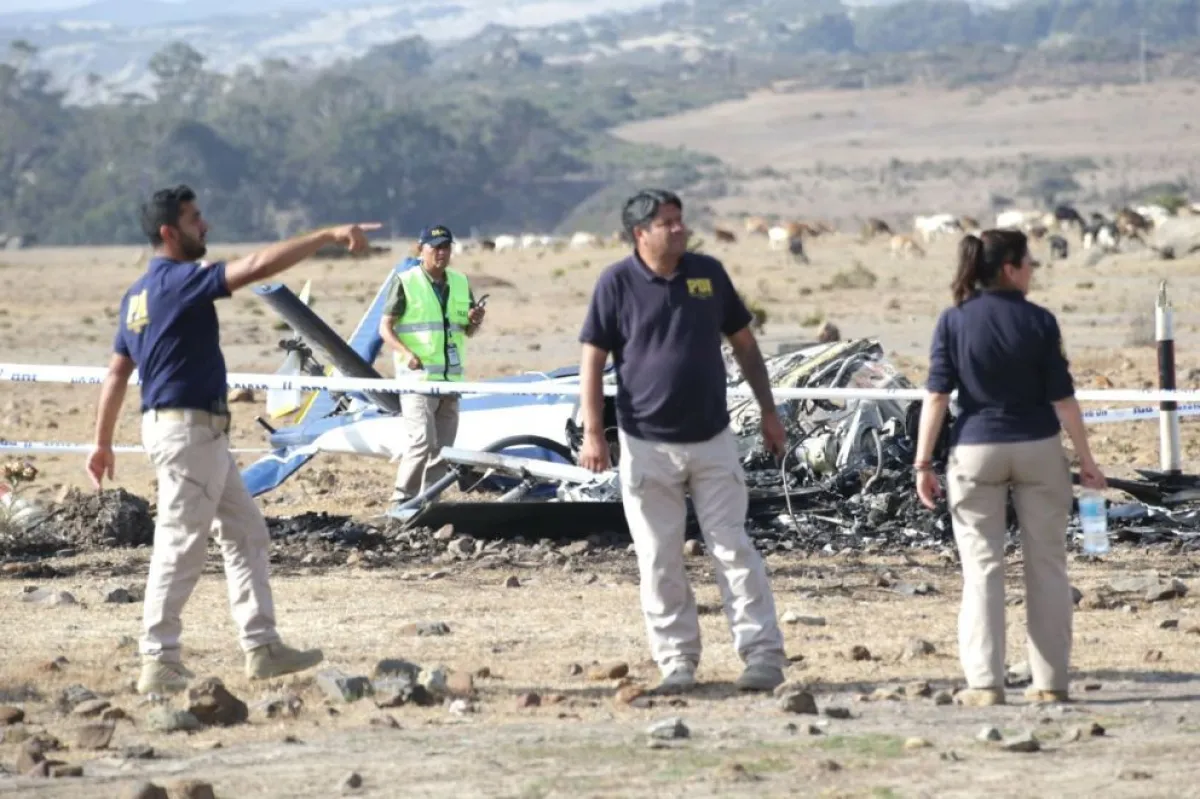
More than two years after the tragedy that claimed the lives of two detectives from the Investigative Police (PDI) in the Coquimbo Region, the judicial investigation remains open with no formal charges filed. However, a key report from the General Directorate of Civil Aeronautics (DGAC), prepared in collaboration with its French counterpart (BEA), is said to have marked a turning point in the investigation in December 2025, indicating human error in the maintenance of the aircraft, as revealed by the TVN program Informe Especial. The incident occurred on January 31, 2024, when a PDI helicopter crashed while carrying out marijuana eradication operations.
On board were Sub-commissioner Camila Silva, Sub-inspector Daniela Zalazar, and pilot Mario Herrera, who survived with serious injuries. According to reports, after a trouble-free takeoff, three consecutive noises were heard from the engine, after which the aircraft lost power. At that moment, pilot Mario Herrera—who had nearly 2,000 flight hours—took control and maneuvered to avoid a greater tragedy, but was unable to prevent the crash.
As a result of the accident, Sub-commissioner Camila Silva and Sub-inspector Daniela Zalazar lost their lives, while two other officials sustained various injuries. The impact caused a fire, fueled by the fuel being transported for the incineration of illicit crops. Herrera, with burns on his hands and legs, managed to exit the aircraft and attempted to rescue his colleagues, but was unsuccessful.
Currently, the pilot remains under investigation, despite the DGAC report concluding that his actions adhered to emergency protocols. In this context, the family of pilot Mario Herrera filed a lawsuit, supported by lawyers Carlos Carmona, Fanny Valdivia, and Claudia Schiele, pointing to potential responsibilities in the maintenance of the aircraft and questioning why, despite the technical evidence, he continues to be treated as a suspect. The legal action claims that the tragedy originated from a general inspection ("major visit") conducted on the helicopter between May 15, 2023, and January 2, 2024.
Just a month after being certified, the aircraft collapsed. According to the DGAC report referenced by Informe Especial…
It was also concluded that the company responsible for maintenance did not meet the standards required by the manufacturer for aircraft over 144 months old, omitting a rigorous inspection package. The judicial document also warns that during the maintenance process, there was a "lack of qualified personnel," high turnover of technicians, and workweeks exceeding 70 hours to service multiple aircraft. Components were reportedly exchanged with another PDI helicopter without strict control.
The pilot's circle has also expressed concern about the physical, psychological, and legal impact he has faced after surviving the accident, insisting that his actions were in line with emergency protocols. The plaintiffs also question that the fuel tank was of a standard model rather than a more resistant one, like those Airbus installs in other countries, which may have contributed to the severity of the fire after the impact. With this information, the prosecutor's office has kept the case open, awaiting new expert analyses, including one related to the fuel tank's resistance.
When consulted by Informe Especial, the Public Ministry declined to comment on the case as it is still under investigation. Airbus Chile expressed regret over the incident and valued the DGAC report pointing to a maintenance failure. Meanwhile, the PDI stated that it has reinforced its safety standards and that the insurer has already paid compensation to the families of the victims.