How much does it cost to disrupt the balance of everyday life? The logic seems simple: the more tedious and linear it is, the greater the impact of its break. In this sense, the suburbs of Florida, with their apparent calm, unbarred houses, and common spaces, become fertile ground for that latent spark which, when ignited, triggers an uncontrollable chain reaction.
As if the harmony of living in community were merely a utopia. The documentary, in its purest form, feeds on these fractures. It is also artifice, aesthetics, a way of decoding the fragment of reality it chooses to show.
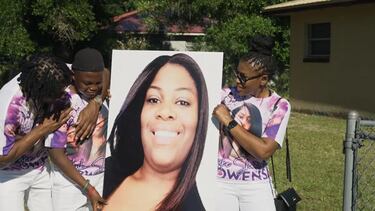
Above all, it cannot be objective, even if it sometimes comes close. The Perfect Neighbor, by American director Geeta Gandbhir, nominated for the 2026 Oscar and available on Netflix, reconstructs the homicide of Ajike Owens, which occurred on June 2, 2023, in Ocala, Florida. A mother of four, she was shot dead by her neighbor, Susan Lorincz, who had inundated 911 with complaints against neighborhood children, especially Owens' children, for alleged trespassing on her property.
The narrative is constructed almost entirely from body camera footage of the police who responded to the calls. From this raw material, the camera becomes a political device, while the documentary attempts a reflection on our contemporary need for reality: that point of no return where things seem to acquire value only if they are instantaneous and raw. As if the invasion of true crime series were not enough to satisfy that visceral demand from the audience.
"I don't bother anyone, I'm peaceful. I'm the perfect neighbor," says Susan, in a statement that dissolves into emptine…
Enthusiastic, noisy, playful. Like in a trial, the records from both sides confront each other. But the scales tip on their own.
Thus, the true intentions of the documentary also emerge. A civic impulse that timidly cultivates, placing at the center the controversial Stand Your Ground law, whose gray areas continue to shape the debate in the United States. Fear, paranoia, and racism intertwine in Susan until they become indistinguishable.
And the question arises: what would have happened if the roles had been reversed? The documentary does not answer this question but makes its stance clear: the outcome, the trial, and the punishment would have been different. Despite being an inert object, the camera does not forget.
It records, exposes, and turns the private into public evidence. It functions as a hinge, increasingly fragile, between reality and its representation. Unlike true crime, there is no mystery to solve here.
There are no twists, only accumulation. A tension that grows in plain sight, inviting the viewer to piece together the puzzle on their own until the outcome becomes an inevitable consequence. After watching The Perfect Neighbor, the fact remains, as does its imprint.
Because in that accumulation of raw images, an uncomfortable question sneaks in: how much do we really see, and how much do we choose not to look at? Perhaps the documentary seeks to question that illusion of clarity. Because even when everything seems to be in plain view, the balance, like life in those peaceful suburbs, can always shatter in silence.