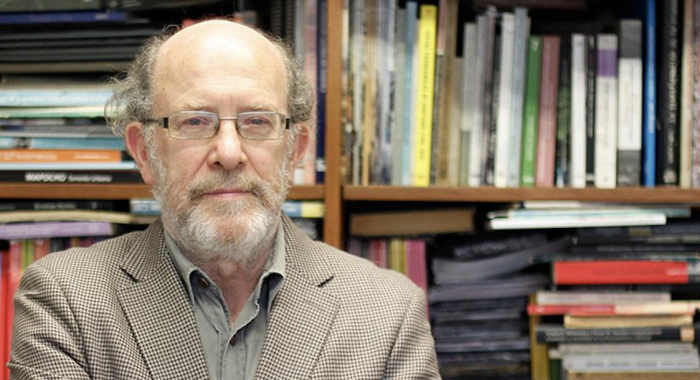
Amid the statements from King Felipe of Spain about the "abuse" that occurred during the Conquest and the controversy surrounding a newly opened nightclub in Madrid, whose owner explicitly stated he did not want "Latin Americans," Professor Miguel Laborde has published a book on Latin American identity. The book is titled "Roots and Branches of Latin America," where he addresses the difficult relationship between Spaniards, Creoles, and Indigenous peoples, and takes a journey through the history of our continent. The essay ranges from Caral, the five-thousand-year-old city in Peru, the oldest in America, to the life journey of Violeta Parra in her recovery of Chilean folklore through her strong connection with Spanish culture, reflecting on our identity as peoples of these territories, with our history and our traumas.
– What is the origin of this book? – In 2024, I decided to leave university teaching and create an open workshop, without tests or exams, for people who, like me, want to sit down and think about Chile. I dedicated it to two topics of Chilean culture that seemed to me, and still seem, to be open wounds that hinder the growth of our society; the relationship with the Indigenous world and the relationship with the Hispanic world.
These are our matrices, our roots, and we get along terribly with both. Since we do not want to be Indigenous or Spanish, we also do not know how to be mestizos, which is what we are. We float, without taking deep roots in any world.
From that course, from its preparation, this book emerged that seeks an approach to both. The workshop participants later asked me to continue with the mestizo eighteenth century, and then the Europeanized nineteenth, and the erratic twentieth, but I don’t think they will turn into books; I prefer, more and more, conversation. – Why did you want to talk about Latin American identity?
– Talking about identity is thinking about what we have in common. If we want to be something more than a collection of…
– What do you attribute the misunderstandings on our continent to, between Spaniards and Indigenous peoples, then Spaniards with Creoles, and Creoles with Indigenous peoples? – I believe that the Spaniards got halfway. It is true that, unlike the colonies of other powers, they mixed with Indigenous peoples, founded universities and hospitals, cities and towns, but, wary, perhaps due to distances, they did not allow autonomy in management, which would have prepared us to develop in every sense.
Instead of forming a network of complementary nations, rich in resources – the English did this better in this aspect – they left the Creoles resentful, ready for an Independence that interrupted relationships. It was a harsh divorce, with many grievances, with secular resentments that are still not resolved. – What is necessary for a meeting between these three entities: Latin Americans, Spaniards, Indigenous peoples?
– I believe that we need to complete the Discovery. I lived a year in Spain and was surprised by the ignorance about Latin America; it is a distance that constitutes a strong, significant, beneficial cultural and economic community for all. It is true that Spain has many internal problems, in addition to external cultural enemies that have left it somewhat marginalized in Western Europe, but we also have not known how to take the first step; we do not want to accept or acknowledge that our origin is a shared braid.
Perhaps, as we are seeing, Felipe VI will be the one who, after recognizing the many abuses, manages to initiate a new time. The Indigenous is, above all, a problem of our republics: we broke with Spain and wanted to be English, French, German, whiter, more European, even if it was second class. Thus, we renounced our Indigenous part, it became a burden in that quest for whitening.
The truth is, only in recent decades – and we must recognize the contribution of archaeologists and anthropologists – Latin America is discovering deep, Indigenous America. Regarding the Indigenous perspective, it still carries resentments and outstanding debts. We have not known how to present a better face; on the contrary, discrimination continues.
– What do you attribute the absence of visibility of the Afro root in Latin American identity to, if 25% claim to have Afro roots? – The Afro presence was very strong around 1800. In the census of Bishop Alday, for example, it did not drop below 5%.
That is why the freedom of wombs was declared first, but decades passed before the end of slavery was fulfilled; they were a fundamental labor force for the economy of the time. Since we wanted to be white, to appear civilized in the European way, the African was also a burden and was marginalized. Something similar happened in varying degrees in all our countries, which confuses our identity; the bolero has part of that root, the tango – even in the name – as well as cumbia, Chilean cueca, so nothing makes sense if the African is excluded.
Sometimes the identity debate, which has lasted more than a century, is tiring, but it will have to continue until we make peace with the face we see every morning in the mirror. Once, on a beach in Guayaquil, at night I approached a bonfire of a group of Afro-Americans; upon learning of my origin, they immediately began to sing: “If you go to Chile…”… Then Argentine sambas, Mexican rancheras, all night, with unforgettable voices and percussion. We have lost time, dignity, respect for ourselves, by denying the Indigenous and the African.
– Do we know who we are as Latin Americans? Are we Western? What do we have from the Spaniards, what from the Indigenous, and is there something that is our own and does not belong to either of these two cultures?
– On a Colombian farm, every morning, in the vases of the exterior corridor, there were beautiful floral arrangements, with flowers from right there. It was a pure Indigenous person who did that every day… There is a sensitivity that is seen in toponymy, in personal names, in myths; everything is poetic, from a poetic that comes from a very sensitive relationship with nature. According to a military historian friend, the Spanish soldier is among the best in history.
Brave, resilient, straightforward, and that generates a pride of being that we Chileans inherit, sometimes excessively, wanting to believe ourselves superior to our neighbors. We are partly Western because we have fed on the ideas of the Enlightenment, romanticism, positivism, and we do not want to renounce all that, but we are not just that; our Indigenous sensitivity emerges in our poetry, songs, narratives, and worldviews that are fully mestizo, just like the creations of a García Márquez or a Gabriela Mistral. We are Indigenous tempered by European education and culture.
Like many, after living a few years in Europe, I discovered myself to be different there, and there I “discovered” the richness of Latin America. Here it is more difficult; it is very hidden. – Finally, what happened during the Outburst with this problem?
Because there was a claim from the Indigenous peoples, their recognition was included in the New Constitution, but apparently the Indigenous peoples themselves massively rejected the proposal, except in Rapa Nui. – There is a very good analysis in Carlos Granés' latest book, about how certain movements of recent decades, very positive and necessary, ecological, feminist, indigenist, animalist, lost their way by becoming excessive, intolerant, experts in cancellations and “funas,” without dialogue, just what Jurgen Habermas defended – as has been recalled in his recent death – as the necessary core of a society. It was a great missed opportunity; it was very painful because we could have grown in all those aspects, to arrive at a more mature Constitution for the 21st century.
We need to dialogue, sit down to converse, to discover each other. A very accurate phrase that Elicura Chihuailaf gave me lingers in my mind: “And when are we going to talk about love?