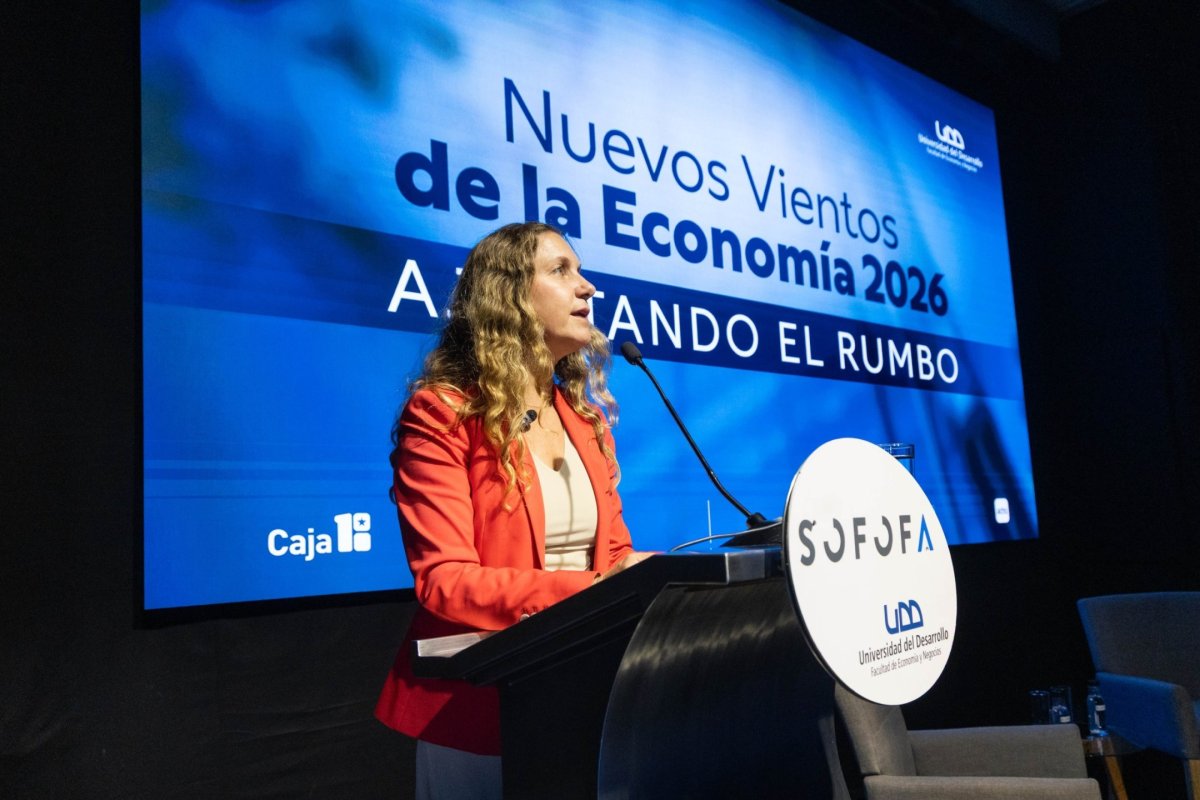
With the participation of economic authorities, business leaders, and representatives from the academic world, a new version of the seminar "New Winds of the Economy 2026: Adjusting the Course" was held on Tuesday, organized by the Society of Industrial Promotion (Sofofa) in conjunction with the University of Development. The meeting, which was attended by the Minister of Finance, Jorge Quiroz, and the President of the Central Bank, Rosanna Costa, began with a speech by the president of the industrial association, Rosario Navarro, who reiterated that the international and local context is complex. "In the last five years, the international scenario has been marked by high uncertainty.
At the beginning of this decade, we faced one of the deepest international economic crises in half a century, initially caused by the pandemic, followed by a sharp increase in prices due to the war between Russia and Ukraine. And just when it seemed that the outlook was beginning to stabilize, new conflicts in the Middle East have once again strained global economic activity and markets," Navarro said. The situation has been characterized by a sustained rise in oil prices - which went from US$ 70 per barrel to US$ 110 per barrel in a matter of weeks - and which, in the eyes of the union leader, anticipates a complex outlook for businesses and households.
"Although the international context is demanding and challenging, we must recognize that we are still facing internal obstacles. We have spent a decade with a trend of lower economic growth, accompanied by greater regulatory uncertainty and a loss of dynamism that has affected not only macroeconomic indicators but also public expectations," she said, adding that the country has experienced 38 consecutive months with an unemployment rate above 8%. Therefore, for Navarro, it is crucial to advance concrete measures to address high levels of tax burden, regulatory uncertainty, and a slow and unpredictable permit system.
From her perspective, this scenario can be addressed through three lines of action. The first relates to the modernization of the permit system, focusing on simplification, the use of technology, and the incorporation of tools such as artificial intelligence to expedite processes and reduce uncertainty in investment projects. "The new Framework Law on Sectoral Authorizations was an important step, but there is still work to be done to expedite the review of the nearly US$ 96 billion in investment projects still undergoing environmental qualification.
We believe it is imperative to use technologies to speed up and ensure the process," Navarro said. The second line of a…
A structural deficit of 3. 6%, above initial estimates, is unsustainable for a country like ours," she asserted. The third area to be addressed is the strengthening of institutional trust, primarily promoting clear rules.
"Evidence shows that economies grow when there are clear rules, institutions that function properly, and actors capable of collaborating with each other. Therefore, now more than ever, it is necessary to strengthen a long-term vision of the state that transcends political cycles and allows for broad agreements on fundamental issues for the country's development," she concluded.