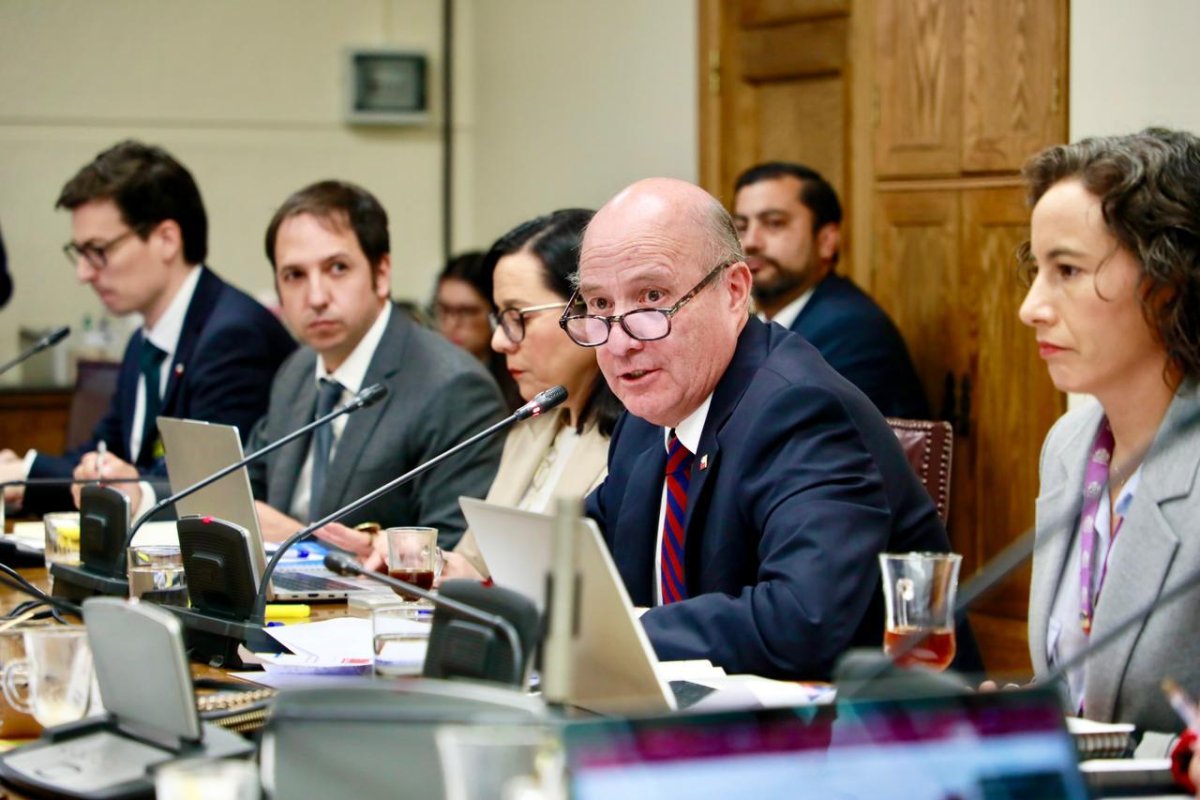
The Senate Finance Committee was the chosen venue for the Minister of Finance, Jorge Quiroz, to inform lawmakers about one of the plans being prepared to increase sovereign funds. Currently, instruments like the Economic and Social Stabilization Fund (FEES) represent only about 1% of the Gross Domestic Product (GDP), whereas during the global financial crisis of 2008, this proportion was around 14% of the economy's size. With this in mind, the Minister informed the senators that he is preparing a program aimed at increasing the size of the FEES, which totaled only US$ 3.
889 billion as of December 2025. He specified that the total asset portfolio owned by the State of Chile will be analyzed, particularly real estate and properties, to evaluate their potential sale and thus allocate these resources to inject into the FEES. As he explained to the lawmakers, the difficulty of recording surpluses in public sector operations complicates the task of allocating those resources to sovereign funds.
Therefore, certain less liquid assets owned by the State—such as land and properties—will be sold to convert them into more liquid assets, which can be invested in the FEES or in the other sovereign fund of the Treasury: the Pension Reserve Fund (FRP). "Advancing in the recomposition of sovereign funds is a very complex task because if we are to restore sovereign funds, one needs not only to reduce the deficit but also to achieve a surplus and reverse the deficit trend. Generating a surplus is already complex.
It is even more complex, and in this matter, one topic we will work on is to look at the Government's entire portfolio differently, because the State of Chile has a portfolio of various assets. When we talk about recovering the Economic and Social Stabilization Fund, we are talking about recovering that part of the portfolio that is liquid, which is in easily liquidated instruments. This means that perhaps there are other illiquid assets that we need to convert into liquid ones," said the Secretary of State.
In fact, he suggested that there are state-owned lands—some of which have been owned for 150 years—that are not being ut…
"We are going to have significant development and—at some point—perhaps think about how the State can sell certain assets and convert those assets not to spend them but to rebuild this state fund," he stated. "We are in a much more complex geopolitical world, and these transformations of assets from illiquid to liquid need to be done gradually, with planning, consensus, agreements, and with the regions. These things work when there are agreements with municipalities, with communities, doing things gradually and learning from experiences, but doing it during positive periods, which is when it can be done," he added.
Properties as inheritance On Tuesday, at a seminar hosted by Sofofa and UDD, the Minister of Finance had already indicated that the Executive was looking to dispose of vacant inheritances in the public sector, which translate into abandoned properties or those used by public officials. Initially, he mentioned 1,200 properties. "We are going to sell them all.
There are about US$ 200 million to US$ 300 million in revenue. There are plenty of assets. Ministries, agencies, even some shelters in La Parva of ministries.
We are going to sell them. We are going to recover the ethical principle because this is no longer just about the economy. There is an ethical principle in managing public finances, the diligence in managing public finances, the diligence we have in administering other people's money, the money of all Chileans.
Every pencil taken, every light turned off, every trip taken is money from all Chileans. And that is the republican sense, in a broad non-political sense, that we must recover. And that is management, but it is management with ethics," he stated.