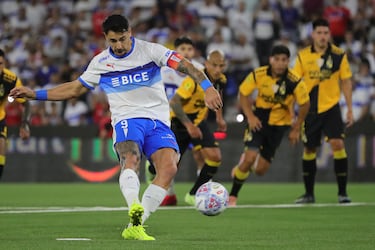
Argentine Ricardo Lunari (56) has a special connection with the Copa Libertadores, a tournament in which he played in the finals of 1992 with Newell’s under Marcelo Bielsa, and in 1993 with Universidad Católica under Ignacio Prieto. In an interview with El Deportivo, the former midfielder discusses the direction of Coquimbo Unido and the Cruzados in the 2026 version of the tournament. How do you see this Libertadores?
The Brazilians are a step above. The Argentines sometimes match them, but I don’t see other teams that can compete on equal terms. Of the four semifinalists, three will be Brazilian.
They hire stars that other countries cannot afford. Is it more about budget or development? It’s a combination of both.
Brazil can buy high-caliber players; in other countries, they are more like bets. There are teams that, like Ecuador at one point, found four or five players with great potential and got into the fight. Does it also relate to player development?
For 30 years, the issues with youth training in Chile have remained the same. There is no investment in lower divisions…
But for smaller teams, it’s difficult; there are no investors willing to invest in youth football. Is it seen more as an expense than an investment? Perhaps in the first five or six years it can be seen as an expense, but this is a long-term game.
Those players who reach the first team add quality, and then a foreign team buys them, which allows for reinvestment, creating a cycle. For over 30 or 40 years, no one in Chile has dared to invest. How do you see the Chilean teams in this Libertadores?
They are well-structured. I liked Coquimbo Unido a lot in the last year; they are strong at home and will likely have good results. The key is to earn points away.
But the team has been dismantled... Something strange happens in Chile. The champion coach always leaves the teams, it’s incredible.
This happened to Católica for five consecutive years. I understand that offers come up, but it’s the moment to give continuity to the project. If I win the championship and get to play in the Libertadores, something interesting can be built to compete, with good reinforcements.
Of course, sometimes the economic difference is so great that it also makes you think about the future. Coquimbo suffered the loss of their coach, and now the new manager must find that functioning. What is the goal?
It is no longer normal for Chileans to advance to the second round of the Libertadores. Getting past the group stage is the minimum aspiration. It’s not common, as it was 25 or 30 years ago.
They may not be able to compete on equal terms against Brazilians or Argentinians, but they are not below Uruguayans, Paraguayans, or Ecuadorians. And how do you see Universidad Católica? Dani Garnero’s continuity has been established.
He is a very intelligent coach and has done very well wherever he has managed. He can bring a lot of satisfaction to Católica, but he needs to be allowed to work. Hopefully, the reinforcements perform well.
There are players who may not have big names, but if one studies or discovers them, they can perform significantly. The foundation of the work that Católica built last year can yield many rewards. I feel that Católica is better positioned to face the Libertadores than Coquimbo.
How do you analyze the Cruzados? They lack the decisiveness they had at another time when they were superior in matches and demonstrated it on the scoreboard, but it’s a project that is on the rise. In 1993, no one expected Católica to reach the final, and it happened.
Hopefully, they can surpass the first phase, better than the recent performances of Chileans who were eliminated in the first round. That wasn’t seen years ago. They will be strong at the Claro Arena; in the Libertadores, that is fundamental.
If they manage to bring in something from abroad, qualifying for the round of 16 is within reach.