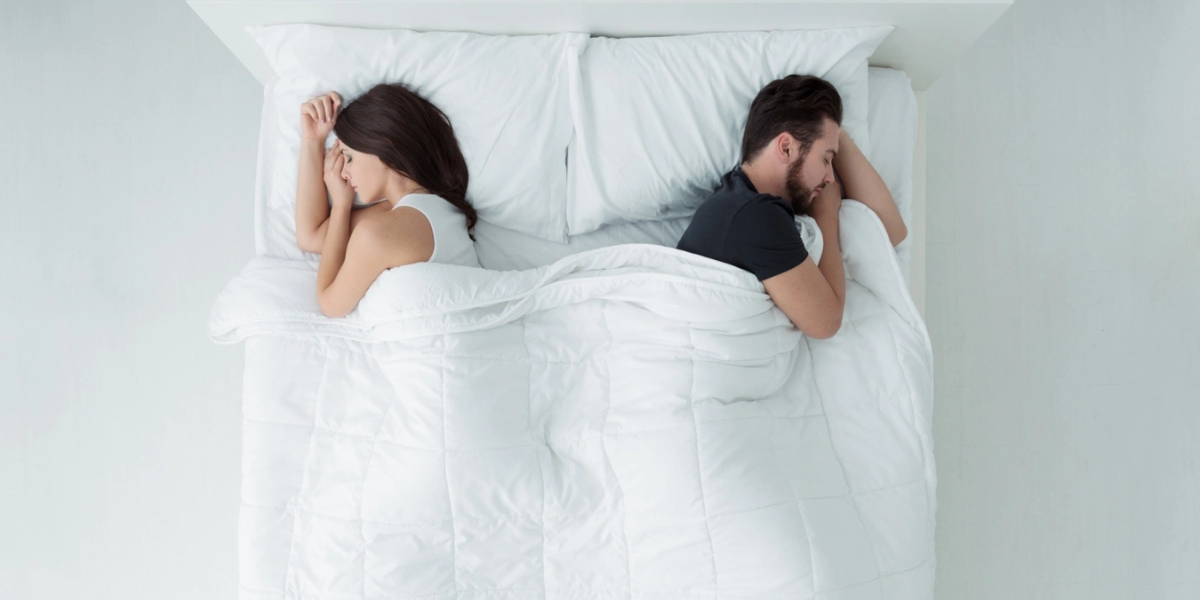
Sleeping in separate beds or rooms, a practice known as "sleep divorce," has gained visibility in recent years. Driven by public figures and health specialists' interest, this trend highlights a new priority: better rest. In the United States, while 82% of couples still share a bed, recent studies indicate that more than a third occasionally or regularly choose to sleep separately to improve their sleep quality, according to the American Academy of Sleep Medicine (AASM).
Far from being a completely new practice, sleeping apart has historical precedents. Until the early 20th century, it was common to share sleeping space with a partner, children, and even other household members. However, with growing health concerns and fears of disease transmission, the idea of separating sleeping spaces began to take hold.
Later, urbanization and changes in housing solidified the "marital bed" as the standard, especially in smaller spaces. Nevertheless, among the elite and royalty, the custom of sleeping in separate rooms persisted, according to specialists cited by BBC Mundo and The Independent. Today, the practice is resurging strongly, especially among people aged 28 to 42.
According to AASM data, 43% of millennials sleep separately from their partners, compared to 33% of Generation X and 22% of baby boomers. This shift is partly due to a reduced stigma: for many, sleeping well is more important than adhering to traditional norms. The conversation has also entered the public sphere.
Actress Cameron Diaz, for example, acknowledged that she does not share a room with her partner, sparking a debate that …
An essay published in 2024 showed that the sleep patterns of couples sharing a bed tend to synchronize. In fact, up to 30% of a person's sleep quality can depend on their partner's rest, highlighting a strong interdependence during the night. In this regard, Dr.
Wendy M. Troxel emphasizes that there is no solid scientific basis that requires couples to sleep together. Sharing or not sharing a bed does not define the success of the relationship, nor does sleeping apart necessarily indicate a problem.
Rather, the decision should focus on the well-being of both partners. Sleep deprivation, specialists warn, can affect empathy, communication, and conflict resolution abilities. Additionally, sleeping separately allows for the personalization of the sleeping environment: choosing mattresses, bedding, or pre-sleep routines without interference.
It also facilitates adapting schedules and habits—such as reading or avoiding screens—which contributes to better sleep hygiene and overall health. The Challenges of Separating Spaces Despite its benefits, "sleep divorce" is not without tensions. One of the main concerns is the potential loss of intimacy and emotional connection.
For many couples, bedtime is a key moment for sharing, conversing, and strengthening their bond. Eliminating that instance could affect daily closeness. Evidence also shows that sleeping together can have positive effects, depending on emotional profiles.
A review based on 179 cohabiting heterosexual couples found that synchronization in time spent in bed is associated with a better perception of sleep quality, especially in women with lower attachment security. This finding suggests that, for some individuals, the presence of their partner during the night can create a greater sense of protection and reduce stress. Ultimately, experts agree that there is no one-size-fits-all formula.
The impact of sleeping together or apart depends on both the relationship dynamics and the psychological characteristics of each person. The key, more than the arrangement of the bed, lies in mutual agreement and prioritizing shared well-being.