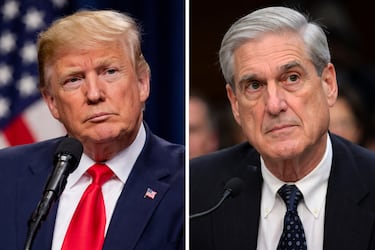
Donald Trump sparked a wave of criticism on Saturday after reacting with a celebratory message to the death of former FBI director Robert Mueller, who led the investigation into alleged Russian interference in the 2016 elections. “Robert Mueller has just passed away. Well, I’m glad he’s dead.
He can no longer harm innocent people! ” the president wrote on his Truth Social platform, a message that quickly generated controversy due to its harshness. New York Congressman Dan Goldman highlighted Robert Mueller's history of service but claimed, “The President of the United States grotesquely celebrates Mueller's death simply because he uncovered Trump's efforts to steal the 2016 election.
” “Mueller and Trump represent opposite poles of what a public servant should be,” he added. Another reaction came from Democratic Senator Chuck Schumer, who stated, “Cruelty is the goal. Trump seeks to distract you from rising gas prices, his senseless war, ICE abuses, and the Epstein files.
Don’t give him what he wants. ” Mueller passed away at the age of 81 after a prolonged battle with Parkinson's disease, according to his family. The former official led the Federal Bureau of Investigation from 2001 to 2013, a period that included his leadership following the September 11 attacks.
However, his figure gained particular political relevance in 2017 when he was appointed special counsel to investigate t…
Nevertheless, the process maintained strong pressure on the White House for years and deteriorated the relationship between Trump and the institutions responsible for the investigation. During that period, Trump did not hide his rejection of Mueller. He repeatedly labeled the inquiry as a “witch hunt” driven by his political opponents, questioning the legitimacy of the process and directly attacking the special counsel.
He even publicly denied having ordered his dismissal, despite the evidence collected in the report itself. The president's criticisms also escalated at public events. In 2019, during a rally, he harshly attacked Mueller and his team, calling them “sick people” and accusing them of trying to remove him from power through unfounded accusations.
This confrontational tone persisted over the years, solidifying a relationship marked by distrust and hostility. Mueller's death thus reopens that chapter of American politics, but it does so amid a new controversy, after the President himself opted for a message that has been widely questioned for its lack of empathy and the level of confrontation even after the former official's passing.