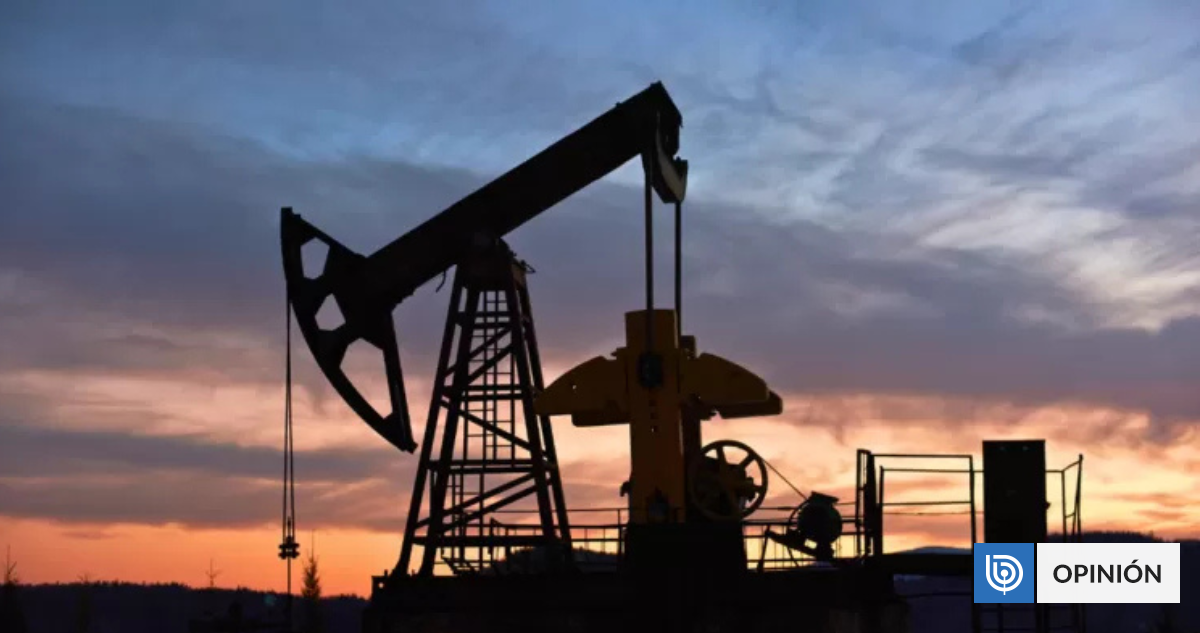
As the price of oil approaches 110 dollars per barrel (159 liters), few remember that the root of the issue lies in the agreements signed in 1974 between the U. S. government of Richard Nixon and the monarchy of Saudi Arabia, that is, between the world's main consumers and producers of crude oil, respectively.
While the presence of American oil companies in the Middle East is older, that year the United States not only secured a strategic supply of oil for the functioning of its economy but also established that the trade of this commodity would be conducted in U. S. dollars.
The U. S. -Saudi agreement marked the end of the emergence of the "oil crisis of 1973," which occurred after OPEC imposed an embargo on sales to governments, like Washington's, that supported Israel in the Yom Kippur War (October of the same year).
Over the months, that crisis caused the price of oil to quadruple, leading to a global recession characterized by inflation and economic stagnation (what economists call "stagflation"). The Yom Kippur War and "the oil crisis of 1973" occurred within the context of the bipolar confrontation in which, while Egypt, Syria, and (to a lesser extent) Jordan received support from the Soviet Union, Israel had American backing. Since then, its geostrategic interest has been "intimately compromised" with the political and geopolitical situation in the Middle East, making the United States the main supporter of Israel.
Over the last five decades, the Israeli lobby in finance and media has consolidated this - as wine connoisseurs would sa…
In the context of the repercussions of "the oil crisis of 1973," American geopolitics took into account that, by the end of the 1960s, its oil industry in the Gulf of Mexico had reached the limits of its production, generating a growing deficit that could only be overcome with crude imported from the Middle East. Additionally, before 1974, production levels (supply) and the subsequent price of oil had become "weapons in the hands of hostile countries" to the strategic interests of the United States. By then, the decline in American oil production had already caused structural imbalances for its economy, affecting its gold reserves.
To resolve that problem, in 1971 the Washington government ended the "gold standard," devaluing its currency and affecting the price of oil (and the net revenues of OPEC countries). To definitively resolve that danger, the United States reached an arrangement with Saudi Arabia that, while exponentially multiplying the "wealth in dollars" of its monarchy (and later also of those of "the Gulf States"), gave the United States the monopoly on the currency in which "the product that makes the world function" is traded. From 1980 onward, the international price of crude was expressed in the so-called Brent oil barrel, initially traded on the International Petroleum Exchange (IPE).
Later, in 2005, that "exchange" was replaced by ICE Future Europe based in London, but closely linked to the New York Stock Exchange. Since the price of Brent is an essential part of transportation costs (of any kind), in practice, international trade and the economies of the world are directly associated with the U. S.
dollar. For example, Russian oil exports allowed its companies to accumulate gigantic volumes of dollars since the 1990s, which not only explain the Russian rearmament under Putin's government but also the investments of the new Russian oligarchy in hundreds of luxury properties (and even popular football teams) in Western countries. The miscalculation of Donald Trump Returning to the Middle East, given that "the pulse" of politics and geopolitics in that region depends - directly - on the "daily level of conflict of the Arab-Israeli problem" (in which, except for Saudi Arabia, Muslim producing countries are "existential enemies of Israel"), the American strategic interest is linked (and exposed) to the ups and downs of that conflict.
In that same context, the "navigability" of the Bab-el-Mandeb and Hormuz straits (through which 12% and 25% of the world's oil, respectively, passes) is of vital importance to the United States. The "Ayatollahs' revolution" of 1979 added Iran to the list of enemies of Israel and the United States, and since then the intervention of the Iranian theocracy in Lebanon, Syria, and Yemen (and now in the Strait of Hormuz) has become a factor of instability for that region. The ongoing American-Israeli military intervention, which aims to completely eliminate that factor, seems to have underestimated the resistance capacity of the Tehran regime, which some analysts even suggest "could win the war without having won any battle.
" In American television talk and comedy shows, it has been said that, in "Trump's war in Iran," so far the main achievement consists of having "revitalized the regime" of Tehran, removing the 87-year-old Ayatollah Ali Khamenei and replacing him with his 57-year-old son, Ayatollah Mojtaba Khamenei. The military and technological superiority of Iran's enemies is undeniable. Even so, all indications suggest that it is not enough for a quick or "surgical" victory like "the capture of Nicolás Maduro.
" While the rise in oil prices benefits certain "producers" and brokers in London and New York, it also affects the entire global economy and, of course, American consumers (for whom "the war in Iran" is beginning to become an internal problem). Globally, among the most affected by the conflict in Iranian oil fields and in the Strait of Hormuz are the countries of the Asia-Pacific, which depend on the navigability of that maritime passage to receive their hydrocarbon supplies from the Persian Gulf (including natural gas). European countries, which have flatly refused to intervene in support of the United States, are also affected.
Surrounded by his peers from Canada and Scandinavia, the Norwegian Prime Minister stated that "this is not our war," to which Trump - who had previously claimed that the war was "won" - called them "cowards. " Earlier, regarding the impasse related to the "American aspiration" over Greenland (a territory of the European Union), Trump had labeled Europeans as "decadent. " Experts in armed conflicts often repeat that "no conflict fits any script" and also that the first thing that becomes outdated in a war is "the initial battle plan.
" Regardless of whether the war in Iran will prolong for a longer time, what has once again become evident is the fragility of an international system in which the "price in dollars of oil" directly impacts the pockets of the global population. At the same time, Donald Trump's "personal decision" to "decapitate the Ayatollah regime" (to produce a paradigm-shifting geopolitical change) seems to illustrate the limits of American power. While this occurs (and Israel's leading role in the conflict encourages a dangerous resurgence of anti-Semitic sentiment worldwide), China, Russia, India, and Brazil (and likely also the Europeans going forward) are reinforcing their conviction that it is urgent to end the geopolitics of petrodollars.
For now, in some significant regional exchanges, the Chinese yuan is already beginning to replace the U. S. dollar.
These are undoubtedly global geopolitical and geoeconomic developments that, for a medium-sized country dependent on oil like ours, have structural importance. From this perspective, while our monetary policy mechanisms (adopted decades ago) are once again showing their relevance and utility, the issue of "the war for oil" highlights the opportunities that Chile has in the field of renewable energies to achieve a greater degree of self-sufficiency and reverse our inconvenient dependence on the mechanism of "petrodollars.