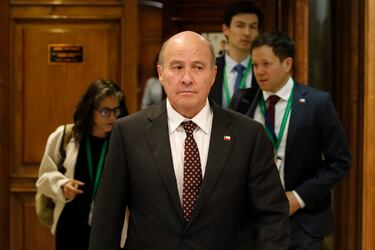
He has power, he knows it, and he does not hide it. Unlike former Finance Minister Mario Marcel, who always avoided calling himself the "head of the economic team" as a strategy to avoid friction with his allies in the Broad Front and the Communist Party, Jorge Antonio Quiroz makes his key role as economic authority in the machinery of the new republican government felt. His debut, marked by the tough and historic decision to raise gasoline prices this week and shortly before by the National Reconstruction Plan, not only showcased him as the most powerful minister in José Antonio Kast's cabinet but also as a strong character willing to assume the political costs of the current administration's economic plan.
"It is not the role of the finance minister to be nice, to get along with everyone, or to be popular. If a finance minister wants to be popular because he is thinking about winning votes tomorrow, then he better not be finance minister and dedicate himself to being popular," said the economist just days before announcing, in interviews with the main news channels, an increase of more than $370 per liter for gasoline and $580 for diesel, along with a package of relief measures. The narrative that the microeconomist sought to establish at the start of the government pointed to the onerous fiscal cost of cushioning and postponing the effect on local prices resulting from the international spike in oil prices, which exceeded $100 per barrel in recent weeks due to the conflict in the Middle East.
The Finance strategy included publicly establishing the impossibility of continuing to finance an expensive mechanism for the treasury - projecting about $160 million weekly - amid the fiscal tightness left by the previous government and the idea of cutting nearly $4 billion by 2026. Quiroz's decision to administratively modify the Fuel Price Stabilization Mechanism (Mepco) and thus transparently adjust gasoline prices for consumers starting last Thursday provoked a harsh attack from the opposition, underlying doubts from the ruling party, and a significant drop in public support for the Kast government this week. "He is the right man for this moment," confided a strategist from the Palace, who highlighted Quiroz's character and acknowledged that his prominence in the cabinet responds to a careful design by the tight republican circle for the start of the government.
"He has a super clear horizon and knows that he is not playing to gain popularity. He is doing what he truly believes, and we support that this is the best decision in the current scenario," insists the same Palace source. But from the beginning, Quiroz marked his character and imprint in the cabinet.
During the first cabinet meeting led by President Kast at La Moneda on Friday the 13th, the minister asked to start prep…
True to his rough and distant character, Quiroz was brief at the press conference, did not accept questions, and left La Moneda abruptly. However, the minister had begun weeks earlier to prepare the political ground to align parliamentarians from his sector for the economic reforms on the table. The meeting between Quiroz and key deputies and senators from the current ruling party took place during lunch in early March at the minister's house.
There, Quiroz sought political support from the parliamentary world for what would be a frantic start to the government. "Indeed, Jorge Quiroz is one of the most important people in the government right now because the magnitude of the problems we have warrants it. He has many challenges, such as getting things in order, generating growth, and avoiding deficits; it is quite complicated, and he has several things to reconcile," acknowledges Agustín Romero, the president of the Finance Commission of the Chamber, who confirms Quiroz's meeting with parliamentarians before March 11.
Just as Mario Marcel did in 2022, Quiroz decided on the nominations of the new heads of the Financial Market Commission (CMF), the Internal Revenue Service (SII), and the Superintendence of Pensions, among others. He also designed the team that will accompany him in Finance, including the key budget director, José Pablo Gómez, an engineer closely connected to the head of public finances. The socialist Mario Marcel, in contrast, had in the Dipres the engineer from the Broad Front, Javiera Martínez, who was proposed by Gabriel Boric for the position.
"Quiroz has more people who speak his language in the government, unlike Marcel, who probably had to evangelize for a while and do a job of economic literacy for his measures to be understood," says Romero when comparing the advantages Quiroz has today in relation to Marcel's management in 2022. But Quiroz has gone further. According to government sources, the head of public finances has led most of the usual bilateral meetings with the economic ministers who entered the cabinet, meetings that were traditionally commanded by the sitting presidents.
"This administration will have much closer coordination on economic matters than many of the governments that preceded us. And the leadership in that coordination will come from Finance," declared the finance minister firmly to DF in January, signaling the preeminence of Teatinos 120 in the cabinet. Agustín Romero anticipates that this leadership of Finance over other ministries and state services will increase in the coming months due to a "capillary" plan developed by Quiroz that will require accountability in various issues.
The announcement of the gasoline price increase this week to avoid greater fiscal bleeding and the start of the National Reconstruction Plan made the finance minister the main protagonist of the two and a half weeks of José Antonio Kast's government, various sources acknowledge. "Quiroz took control of the agenda from the beginning and became the absolute protagonist of the cabinet, which demonstrates his power. Although it is part of the design, that unopposed dominance in the cabinet is also a double-edged sword," admits a government source close to Quiroz.
"Quiroz prefers to turn red once rather than several times... that explains the abrupt and one-time transfer in gasoline prices this week. This strategy is also shared by Kast and his close team," recounts another government source residing in La Moneda.
Republican deputy Agustín Romero reaffirms this view: "At some point, and that's why I find great value in what Jorge Quiroz did, someone has to turn red and say 'no more. ' Are we going to respect the fiscal rule? Are we going to respect the debt ceiling?
Why did we bring him here? Because if we bring someone to act crazy and go ask for a loan, we might as well have brought another economist," the parliamentarian stated. However, the lack of checks on the finance minister in the cabinet is a topic that is beginning to seep into the hallway conversations of La Moneda.
Sources from the republican world acknowledge that there were hesitations from some leaders of the ruling parties in decreeing a historic increase in fuel prices all at once, as the Finance Ministry decided this week, given its political and social impact. "It could have been a more gradual transfer and not a single blow. The feeling is that no one in the cabinet stopped Quiroz in a decision that is generating a high political cost.
That task was for the interior minister (Claudio Alvarado)," points out the same source. A high Palace source acknowledges Quiroz's empowerment and the lack of economic and political checks in the cabinet. He recalls that, unlike the current government, there was a greater balance of opinions in Sebastián Piñera's first government.
The presence of Finance Minister Felipe Larraín, his counterpart in Economy, Juan Andrés Fontaine, and the President himself provided greater checks to the cabinet at that time. "My main economic counterpart was always President Piñera. He not only knew a lot about economics but also liked to talk about economics," recalls Felipe Larraín himself.
Another occupant of La Moneda, however, recognizes in commercial engineer and businessman Alejandro Irarrázaval, the influential head of advisors on the Second Floor and friend of José Antonio Kast, a sort of technical counterpart to the finance minister in these two and a half weeks of government. "Irarrázaval is usually in meetings with Minister Quiroz and the President. They both talk a lot and bounce ideas off each other in meetings.
They have a good relationship," confides the same source. But another authority from La Moneda downplays the situation. "I'm not too worried about the lack of checks in the cabinet because the Second Floor is quite strict, rigorous, and also has a good sense of both technical and political matters," he explains.
For many right-wing parliamentarians, Quiroz's first landing in Congress this week, regarding the relief project for the gasoline price increase, was a "reality check" for an economist used to negotiating with executives and business owners during his years in private consulting. "This time there were parliamentarians who shouted at him in the hallways of Congress to complain. Parliament has a different language and codes, and negotiations are done in a way that Quiroz is not used to," says a right-wing parliamentarian, who acknowledges the lack of experience and political "grit" of the University of Chile economist.
A Palace strategist, however, highlights that Quiroz has "grown" politically during this period, although he admits some cracks in his learning as a minister. In fact, the right acknowledges it was a mistake for Quiroz to initially suggest the idea of ending the Mepco, which he later had to discard because it required going through Congress. That change in a few days was read as a lack of design and political calculation by the minister, close sources acknowledge.
But the lack of experience was also evident during the launch of the National Reconstruction Plan, which includes measures for the reactivation of construction. On that occasion, Quiroz aired one of the tasks that Catherine Tornel, the new president of the Financial Market Commission (CMF), intends to address, which relates to "revisiting some banking regulations and seeing if we are up to date, or if we are not imposing excessive burdens on granting credit, particularly mortgage credit. " The CMF is an autonomous body and of transversal sensitivity.
While sources in the Palace consider Quiroz a symbol of republican identity, they also recognize that the character shown at the beginning of the Kast era carries risks. A former minister from Sebastián Piñera's governments who has known Quiroz for over 20 years highlights his autonomy but admits he has a strong style and personality. "He has his ideas and is difficult to guide.
For much of his professional career, he has been an independent professional, his own boss, with a team beneath him. He is not used to sharing visions, but he also has a lot of negotiation experience with third parties given his previous position," explains the same source, who adds that at this stage "the brusqueness has the advantage of showing authority. " According to those close to the minister, economist Juan Andrés Fontaine and former minister Felipe Larraín are people he respects and listens to continuously.
The latter insists that Quiroz is the right person for a moment like this and downplays any potential pitfalls in his personality. "He has had the spotlight. I've known him for 30 years, and Minister Quiroz is quite likable (laughs).
What he means (when he talks about not seeking to be popular or likable) is that he is here to do the job," Larraín asserts to this newspaper. Larraín himself acknowledges that he has been in continuous conversation with Quiroz recently. "He sometimes asks for my opinion, and I sometimes don't call him, but I send him WhatsApp messages (...
) Jorge is a person who listens to advice, ideas, and different proposals and has the ability to process those arguments and, if he sees it necessary, make adjustments," highlights the former finance minister. A high Palace authority who requested anonymity also recognizes an evolution in Quiroz's personality: "He knows the ups and downs of his character and seeks not to appear angry. So far, he has never 'exploded' in the meetings we have had; he is careful.